
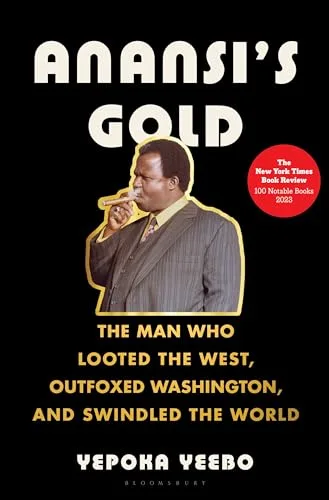
Anansi's Gold
The Man Who Looted the West, Outfoxed Washington, and Swindled the World
by Yepoka Yeebo
- Published
- 2023
- Pages
- 400 pages
- Publisher
- Bloomsbury
- Readers
- 0 members have read this
The story of John Ackah Blay-Miezah, a Ghanaian con man who spent the 1970s and 1980s selling investors shares in a nonexistent fortune supposedly hidden in Swiss banks by Kwame Nkrumah. Yeebo's prize-winning account shows how a plausible story, official cover and greed for outsized returns kept an advance-fee fraud alive for two decades.
In 1974, while serving a prison sentence for fraud, Blay-Miezah got himself brought to Ghana's military ruler, Ignatius Kutu Acheampong. He claimed that Kwame Nkrumah, the country's ousted first president, had hidden a fortune in Swiss vaults and that only he could unlock it. He walked out with his freedom and a diplomatic passport, then spent two decades selling a piece of the so-called Oman Ghana Trust Fund to Philadelphia lawyers, London financiers and Seoul businessmen. Investors paid to free the money; the money never came.
Yeebo, a journalist raised in London who has lived and worked in Ghana, and whose work has appeared in the Guardian, the Atlantic and Bloomberg Businessweek, spent about six years on this, her first book. She worked from diplomatic cables, microfilmed newspapers, the Philadelphia Evening Bulletin's clipping archive at Temple University and interviews with surviving participants.
What lifts it above a caper is context. Yeebo shows the con worked because a bigger lie preceded it: after the 1966 coup that toppled Nkrumah, which the U.S. and Britain helped bring about, the junta claimed he had stashed the nation's gold abroad. The supporting cast includes Shirley Temple Black as U.S. ambassador and Nixon's attorney general John Mitchell, whose consulting firm lent the scheme credibility. It won the Jhalak Prize and the Plutarch Award and was a New York Times Notable Book.
Kirkus noted that it sometimes reads like a breathless caper, and Yeebo tells it with a storyteller's relish rather than in a forensic register. Read it alongside Diana Henriques's The Wizard of Lies to see the same investor psychology at work in a Wall Street setting. It is ideal for anyone in due diligence, compliance or emerging-markets investing.
- The best frauds borrow a true story. Blay-Miezah's pitch worked because Ghana's rulers had already claimed Nkrumah stashed money abroad. A con anchored to a widely believed narrative is far harder to dismiss.
- Advance-fee schemes run on sunk costs. Investors paid to free a fortune, then paid again to protect what they had already put in. Each new delay became a reason to invest more rather than walk away.
- Official cover is not verification. A diplomatic passport, government backing and a former U.S. attorney general's firm all made the scheme look vetted. None of them confirmed that the money existed.
- Prejudice blinds diligence. Kirkus notes that Western investors' assumptions about Africa made an implausible story easier to accept. Diligence that relies on stereotypes about a market instead of documents is no diligence.
- Political chaos is a con man's alibi. Each coup or change of government gave Blay-Miezah a fresh explanation for why the payout was late. In any deal, delays blamed entirely on outside events deserve extra scrutiny.
Yeebo frames the book as a chase across continents and decades, opening in 1974 and then circling back to explain how Ghana's history made the con possible.
- The prison meeting. The book opens with Blay-Miezah, jailed for fraud, persuading Acheampong's debt-strapped government that Nkrumah's hidden millions could rescue the economy, in exchange for his release and a diplomatic passport.
- Origins. Yeebo goes back to his poor Nzema childhood, his teenage turn as a healer, and his years in Philadelphia, where he worked as a waiter at the Union League Club while borrowing a credential he never earned. She sets this against Ghana's 1957 independence, Nkrumah's rise and the 1966 coup.
- The trust fund. Through the 1970s and 1980s he sells stakes in the fictitious fund to investors on several continents, enlists John Mitchell's firm and Ghanaian officials, and uses each coup or political crisis as the excuse for why the payout is delayed, all while evading prosecutors in Ghana and the FBI.
- Unraveling. A 1989 60 Minutes segment brands him the ultimate con man, yet successive Ghanaian governments keep entertaining his claims until his death in 1992. Yeebo closes by asking what really became of Ghana's missing wealth and how a lie became part of the nation's history.
Reader reviews
No reviews yet. Join to write the first one.