
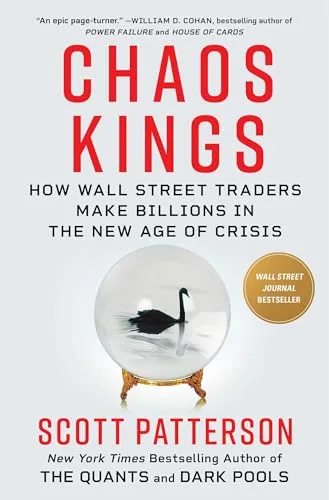
Chaos Kings
How Wall Street Traders Make Billions in the New Age of Crisis
- Published
- 2023
- Pages
- 336 pages
- Publisher
- Scribner
- Readers
- 0 members have read this
Two schools of extreme-risk thinking collide here: Nassim Taleb and Mark Spitznagel's Black Swan tail hedging, which earned Universa a reported 4,000-plus percent in the early-2020 crash, and Didier Sornette's Dragon Kings, crises he believes can be forecast. Scott Patterson's book is a clear primer on tail risk, put options and the cost of ruin.
Patterson frames the book as a contest over how to invest in a world of pandemics, climate change, cyberattacks and superpower rivalry. One camp, led by Nassim Nicholas Taleb, holds that the biggest disasters cannot be predicted, only insured against. Taleb's longtime collaborator Mark Spitznagel turned that view into Universa Investments in 2007, buying cheap, deep out-of-the-money index puts as portfolio insurance; the book cites an audit showing an average annual return of 105 percent on invested capital from 2008 through 2019 and a gain of more than 4,000 percent in early 2020. The other camp follows Didier Sornette, a complexity theorist at the Financial Crisis Observatory in Zurich, who argues that some extreme events, which he calls Dragon Kings, give off measurable warning signs.
Patterson spent nearly two decades as a reporter, mostly at The Wall Street Journal, and wrote The Quants (2010) and Dark Pools. His access shows in the origin stories: Spitznagel's apprenticeship in Chicago under trader Everett Klipp, the Empirica partnership with Taleb, and the influence of Benoit Mandelbrot.
Kirkus praised its lucid handling of complex economic and scientific theory but found the outlook unremittingly gloomy, and Publishers Weekly compared its accessibility to The Big Short. The biggest caveat is the final part, which leaves trading behind for climate change and existential risk. One reviewer at the Mises Institute found that section one-sided in its politics, and another at Advisor Perspectives felt Patterson took Taleb and Spitznagel's claims too readily at face value.
Read it, especially the first two parts, to understand tail hedging and why a small, steady insurance cost might let a portfolio hold more equities.
- Insurance can raise returns. Spitznagel's approach keeps about 97 percent in stocks and spends about 3 percent on deep out-of-the-money index puts, betting that crash protection lets a portfolio stay invested instead of diluting it with lower-returning assets.
- Avoid ruin first. A strategy that can be wiped out eventually will be; Patterson's account of a fund losing most of its capital almost overnight in 2020 makes the point concrete.
- Fat tails break normal models. Following Mandelbrot, both camps reject risk models that understate how often extreme moves happen, which is why tail puts can be cheap relative to what they pay in a crash.
- Some crises may leave fingerprints. Sornette's Dragon Kings work argues that bubbles can show measurable instability before they burst, a counterweight to pure fatalism about forecasting.
- Tail hedges cost money most of the time. Puts usually expire cheaply and pay off rarely but enormously, so the strategy only works if it is sized small and held through long stretches of small losses.
An introduction, Hell Is Coming, sets the stakes, and the book then runs in three parts.
- Swans & Dragons. The longest part traces the roots of both camps: Taleb's options trading and Mandelbrot's fat-tailed mathematics, Spitznagel's training under Everett Klipp, the Empirica partnership and the 2007 launch of Universa, set against Sornette's Dragon King theory and his forecast of the mid-2000s housing bubble.
- Fat-Tail City. The theories meet markets under stress, including the pandemic crash of early 2020, when Universa's hedges paid off on a huge scale while another fund lost most of its value almost overnight.
- The Wicked Problem. Chapters including Ruin Is Forever, The Tipping Point and Beyond and Flying Blind apply tail-risk thinking to climate change, systemic risk and the precautionary principle, closing with Doorstep to Doom.
The arc moves from portfolio insurance for individual investors to the question of whether society as a whole can hedge against catastrophe, and which camp, prediction or protection, offers the better guide.
Reader reviews
No reviews yet. Join to write the first one.