
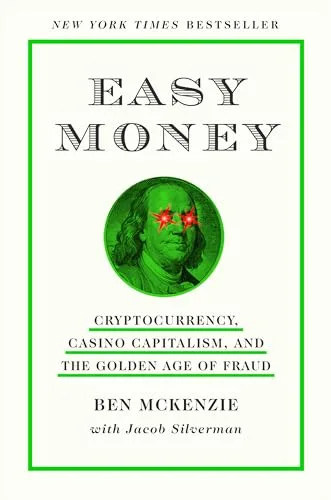
Easy Money
Cryptocurrency, Casino Capitalism, and the Golden Age of Fraud
by Ben McKenzie and Jacob Silverman
- Published
- 2023
- Pages
- 304 pages
- Publisher
- Abrams Press
- Readers
- 0 members have read this
An actor with an economics degree and a tech journalist set out to learn whether crypto was a scam and spend the book showing that it was. Built on interviews with Sam Bankman-Fried, Alex Mashinsky and Brock Pierce, it is a skeptic's field report on the 2020-2022 bubble and a clear guide to the leverage, hype and stablecoin games behind the crash.
Stuck at home during the pandemic, Ben McKenzie, best known for The O.C. and Gotham, started reading about crypto and concluded that it behaved like gambling: tokens tied to no underlying asset, sold with celebrity endorsements to people who could least afford to lose. With journalist Jacob Silverman, author of Terms of Service, he turned that suspicion into reporting. The book's claim is blunt: crypto was one of the great frauds in history, and the 2022 crash was its predictable end.
McKenzie holds an economics degree from the University of Virginia and testified before the Senate Banking Committee at its December 2022 hearing on FTX's collapse. The book records his and Silverman's interviews with Sam Bankman-Fried, Celsius founder Alex Mashinsky and Tether cofounder Brock Pierce, along with reporting trips to El Salvador and SXSW.
Its strength is the explanation of mechanics: how Tether and other stablecoins worked, how Terra's Luna lost around $40 billion in a week, how FTX inflated itself, and why celebrity promotions by figures such as Matt Damon and Kim Kardashian, whom the SEC fined $1.26 million over EthereumMax, deserved more scrutiny. It was longlisted for the FT Business Book of the Year and became a New York Times bestseller.
Kirkus called the case well reasoned but at times shrill, and Publishers Weekly called it a polemic; this is advocacy as much as reporting. It went to press before Bankman-Fried's trial; Zeke Faux's Number Go Up and Michael Lewis's Going Infinite, both published later in 2023, cover FTX in more depth. A good primer for anyone fielding client questions about digital assets.
- Ask what backs the asset. Unlike a share of stock, most tokens have no claim on earnings or assets, so their price depends entirely on new buyers arriving. That makes them closer to a casino chip than a security.
- Stablecoins are the system's weak joint. Tether and similar coins act as the industry's dollars. If the reserves behind them are opaque, every exchange that relies on them carries hidden credit risk.
- Yield without a source is a warning. Celsius promised high returns on deposits under the slogan Unbankrupt Yourself. When the 2022 crash hit, it ended in Chapter 11 and customers' savings were wiped out.
- Celebrity endorsement is marketing, not diligence. Paid promotions from stars helped pull retail money into the boom. The SEC's $1.26 million penalty against Kim Kardashian shows regulators eventually treated it as securities promotion.
- Regulatory gaps invite fraud. Much of the damage happened because no agency clearly owned the market. Products that look like deposits or securities should be judged by the standards for those products, whatever the label.
The book moves from McKenzie's own conversion to skepticism, through the boom's major players, to the collapse of 2022 and its fallout. After an author's note, it unfolds roughly in four phases:
- Money and lying. The opening chapters, including Money and Lying, What Could Possibly Go Wrong? and Money Printer Go Brrr, lay out McKenzie's case that crypto is gambling dressed up as finance, and explain stablecoins such as Tether, which the authors liken to amateurs handed their own money printer.
- Selling the dream. Chapters such as SXSW, the CIA, and the $1.5 Trillion That Wasn't There and The Business of Show turn to the hype machine: conferences, influencers and celebrity endorsements.
- Crypto on the ground. The World's Coolest Dictator follows El Salvador's Nayib Bukele and his troubled government-backed Bitcoin rollout, and Who's in Charge Here? takes up the question of who, if anyone, was regulating the market.
- The crash. Unbankrupt Yourself, named for Celsius's marketing slogan, and Chapter 11 follow the 2022 failures of Celsius, Terra-Luna and FTX, including the authors' interviews with Mashinsky and Bankman-Fried, before an epilogue weighs who, if anyone, will be held to account.
Reader reviews
No reviews yet. Join to write the first one.