
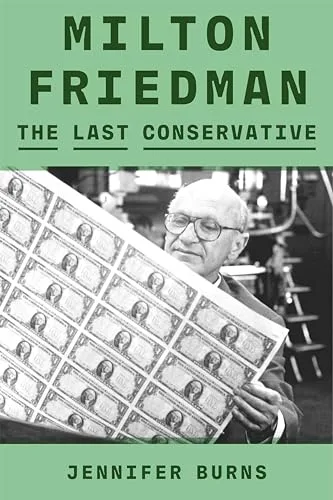
Milton Friedman
The Last Conservative
- Published
- 2023
- Pages
- 592 pages
- Publisher
- Farrar, Straus and Giroux
- Readers
- 0 members have read this
Stanford historian Jennifer Burns wrote the first full biography of Milton Friedman built on his archives, tracing how a boy from Rahway, New Jersey became an economist rivaled in influence only by Keynes and a founder of modern American conservatism. For finance readers, it explains where monetarism and today's arguments about the Fed came from.
Burns treats Friedman as three figures at once: technical economist, policy designer and political actor. She follows his work on consumption and the permanent income hypothesis, the Monetary History of the United States he wrote with Anna Schwartz, his reinterpretation of the Great Depression, his long critique of the Federal Reserve, his challenge to the Phillips curve and his proposal for a negative income tax. Her argument, compressed into the subtitle, is that Friedman helped invent both a new economic vision and modern American conservatism, making him the country's first neoliberal and perhaps its last great conservative.
Burns teaches history at Stanford and is a research fellow at the Hoover Institution, which holds the Milton Friedman Papers. Her earlier book, Goddess of the Market (2009), was an intellectual biography of Ayn Rand. The archives let her document Friedman's relationships with Arthur Burns and George Shultz and his collaborations with women economists, among them Schwartz, Dorothy Brady, Margaret Reid and his wife, Rose, whose contributions he did not always fully credit.
City Journal called it the standard reference on Friedman's life and praised her measured handling of his ties to Chile under Pinochet. She is not uncritical: she argues that his alliance with Barry Goldwater fused libertarian economics with reactionary populism, and that his stance on the civil rights movement reflected a narrow idea of freedom. Publishers Weekly found it somewhat dry; City Journal found it overstuffed with minor detail yet thin on Free to Choose, school choice and his later radicalism, and said the case for the subtitle is underdeveloped.
Read it for the roots of today's debates over money, inflation and the central bank.
- Money matters. Friedman's monetarism tied inflation to the money supply and put the central bank at the center of controlling it. Much of today's argument about the Fed still runs on terms he set.
- The Depression was a policy story. His work with Anna Schwartz reinterpreted the 1930s and made the Federal Reserve's conduct central to the explanation, a view that shapes how policymakers respond to crises.
- Influence travels through people. Friedman's ideas spread as much through relationships with officials such as Arthur Burns and George Shultz, and through political alliances, as through journals.
- Credit the collaborators. Burns shows how Schwartz, Brady, Reid and Rose Friedman shaped work that carried his name, a reminder that research reputations often hide team efforts.
- Good policy design outlasts ideology. Friedman's negative income tax helped inspire the Earned Income Tax Credit, showing how a market-friendly mechanism can win support across party lines.
The biography moves chronologically, setting Friedman's ideas against his life and times.
- Formation. A childhood in Rahway, New Jersey, study at Rutgers and graduate training at the University of Chicago, where Frank Knight, Henry Simons and Aaron Director shaped him; the Great Depression forms his views on freedom and government.
- Washington and New York. Years working outside academia during the New Deal and wartime, before he settles at Chicago.
- The Chicago economist. Research on consumption and the permanent income hypothesis, the Monetary History with Anna Schwartz, and the building of monetarism as a challenge to Keynesian economics, with Schwartz, Brady, Reid and Rose Friedman as collaborators.
- Into politics. His alliance with Barry Goldwater, the negative income tax, the attack on the Phillips curve and his clashes with his old mentor Arthur Burns as inflation takes hold in the 1970s.
- Global reach and controversy. His involvement with Chile under Pinochet and his role in the turn toward free-market policy that gathered force in the 1980s.
- Legacy. Burns concludes that by century's end many of Friedman's goals had become reality, and asks what kind of conservatism he left behind.
Reader reviews
No reviews yet. Join to write the first one.