
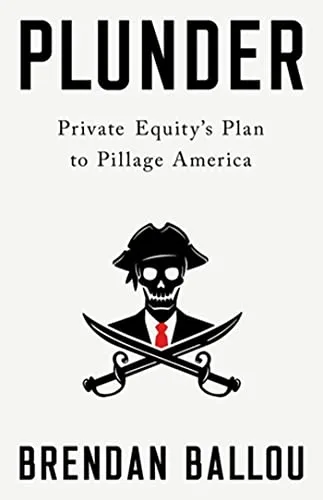
Plunder
Private Equity's Plan to Pillage America
- Published
- 2023
- Pages
- 368 pages
- Publisher
- PublicAffairs
- Readers
- 0 members have read this
A federal prosecutor who served as the Justice Department's special counsel for private equity lays out the industry's playbook (leverage, fees, sale-leasebacks, dividend recaps) and follows it through retail, nursing homes, health care, prisons and local government. It is the prosecution's case against the buyout model, with a reform agenda attached.
Private equity firms such as Blackstone, Carlyle and KKR are among the largest employers in America, yet few people outside finance understand how they make money. Ballou's answer is that too often the profits come from extraction rather than improvement: buy a company with mostly borrowed money, load the debt onto the company, charge fees, sell its real estate, pay out dividends, and walk away if it fails. He argues that the law, through bankruptcy rules, arbitration clauses and light regulation, actively shields firms from the consequences.
Ballou is a federal prosecutor who served as Special Counsel for Private Equity in the Justice Department's Antitrust Division, after stints in private practice and the department's National Security Division. This is his first book, and it reads like a well-organized legal brief.
The cases are specific. Sun Capital bought Marsh Supermarkets in 2006, sold the land under its stores and steered it into a bankruptcy that shed pension obligations. Carlyle's $6 billion ManorCare deal ended with the nursing home chain paying rent on buildings it once owned and sliding into insolvency. Further chapters cover physician staffing firms and rising medical bills, prison phone services, rental homes and roll-ups of dental practices. Publishers Weekly called it a fiery debut with a convincing reform agenda, and Kirkus rated it a Get It.
This is a prosecutor's argument, and the industry's defense, including returns to pension funds and successful turnarounds, gets little space. Read it alongside Gretchen Morgenson and Joshua Rosner's These Are the Plunderers. It is required reading for anyone headed into buyouts, leveraged finance or distressed debt who wants to understand the critics.
- Follow the debt. In a leveraged buyout the borrowing sits on the acquired company's balance sheet, not the sponsor's. The sponsor's downside is capped while the company carries the risk.
- Fees and dividends can pay before performance does. Monitoring fees, transaction fees and dividend recapitalizations let a sponsor recover its equity early, so a deal can be profitable for the firm even if the company later fails.
- Sale-leasebacks turn assets into liabilities. Selling a company's real estate and leasing it back raises cash today but locks in rent that can sink the business in a downturn, as Ballou's ManorCare and Marsh cases show.
- Roll-ups are an antitrust question. Buying dozens of small dental or medical practices one at a time can build market power that no single deal review catches. Ballou wants regulators to examine the pattern, not just each deal.
- Legal structure shapes the outcome. Arbitration clauses, bankruptcy rules and the separation between fund and portfolio company determine who absorbs losses. Diligence on any private equity-owned counterparty should start there.
The book opens by describing a new Gilded Age, explains the industry's tactics, and then moves industry by industry before closing with reforms.
- How the model works. The opening chapters set out the mechanics: leveraged buyouts that put the debt on the target company, monitoring and transaction fees, sale-leasebacks of real estate, and debt-financed dividends, along with how government policy enables them.
- Retail and nursing homes. Ballou traces chains such as Marsh Supermarkets, Shopko and Toys "R" Us, and Carlyle's ManorCare, where asset sales and rising rent loads left businesses fragile and patients and workers worse off.
- Health care and finance. Chapters follow physician staffing companies such as TeamHealth and EmCare and the costs passed on to patients, then private equity's reach into consumer finance, from payday lenders to mortgage servicing.
- Prisons, courts and local government. Ballou looks at prison phone provider Securus, at how arbitration clauses and bankruptcy law limit firms' liability, and at towns that have handed ambulances, firefighting and 911 dispatch to private equity-owned operators.
- Reform. The closing chapter offers an agenda for regulators and lawmakers, including a ban on debt-funded dividends, caps on executive pay after layoffs and closer scrutiny of roll-ups.
Reader reviews
No reviews yet. Join to write the first one.