
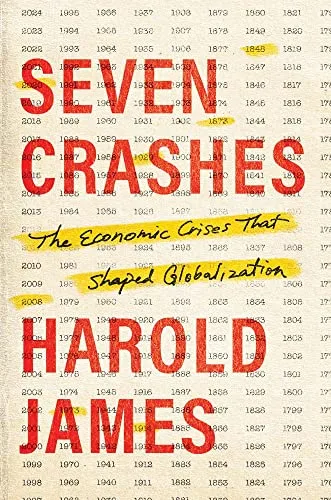
Seven Crashes
The Economic Crises That Shaped Globalization
by Harold James
- Published
- 2023
- Pages
- 376 pages
- Publisher
- Yale University Press
- Readers
- 0 members have read this
Princeton economic historian Harold James sorts 170 years of crashes into two kinds: supply shocks, which tend to push the world economy to knit together, and demand shocks, which tend to make it retreat. For anyone weighing inflation, supply chains or deglobalization risk, it offers a historical test for which kind of crisis we are in.
Harold James walks through seven turning points, from the famine-and-revolution years of the 1840s and the crash of 1873 to World War I and the hyperinflations that followed, the Great Depression, the Great Inflation of the 1970s, the 2008 financial crisis and the Covid lockdowns of 2020-22. His thesis is simple and portable. Shortages, like the oil shocks of the 1970s, force producers to innovate and widen markets, so globalization deepens. Collapses in demand, like 2007-08, shrink markets, bring austerity and leave voters suspicious of government.
James holds the Claude and Lore Kelly chair in European Studies at Princeton, is the IMF's official historian and wrote The End of Globalization as well as a history of the Bank of England. That institutional background shows in his ease with central banks, sovereign lenders and policy debates on both sides of the Atlantic. The book was shortlisted for the Lionel Gelber Prize.
What sets it apart from standard crisis histories is the cast. Each episode comes with a portrait of the thinker who framed it: Marx, Jevons, Keynes, Hayek, Friedman, Bernanke and Larry Summers all get extended treatment, alongside operators like Ivar Kreuger, whose Swedish Match empire collapsed after 1929, and the Hunt brothers and their silver corner. Reviewers had reservations. Brad DeLong argued that only the 1970s fits the supply-shock story cleanly and that 1873 was a plain speculative bust. The LSE Review of Books found the chapter titles cryptic and the anecdotes somewhat haphazard.
Read it if you want a long-run frame for the post-Covid inflation and the fight over supply chains, and if you enjoy economic history told through people rather than tables.
- Ask which shock you are in. James's core test is whether a crisis starts with too little supply or too little demand, because the answer predicts whether markets widen or close afterward.
- Shortages can be productive. The 1970s oil crises pushed producers toward new supplies and new technology, and the world economy came out more integrated.
- Demand collapses breed retreat. After 1929 and again after 2008, falling demand brought protectionism, austerity and lasting distrust of governments and markets.
- Inflation does damage beyond prices. The postwar hyperinflations destroyed faith in saving and in finance itself, and that loss of trust shaped politics for a generation.
- The economist in the room matters. Responses to each crash followed the ideas of the day, from Keynes to Friedman to Summers, so knowing who is advising policymakers helps you anticipate the response.
The book moves chronologically, one crisis per chapter, between an introduction that lays out the supply-versus-demand framework and a conclusion that looks ahead to the next phase of globalization.
- The 1840s and 1873. Harvest failure, hunger and the revolutions of 1848 give way to a rethinking of government and finance, with Marx as the guide. The 1873 crash, the first to be called a Krach, shows how far a speculative bust can travel once capital moves freely.
- War and hyperinflation. World War I and the postwar inflations, Germany's above all, wreck savers and erode trust in thrift, finance and foreign trade, damage James treats as political and moral as much as economic.
- The Great Depression. Keynes becomes the lens for a demand collapse. Kreuger's empire falls, and tariffs and migration limits start a retreat from globalization that lasts beyond World War II.
- The Great Inflation. The 1970s oil shocks are James's model supply crisis: painful at first, then a spur to innovation and wider markets.
- 2008 and the lockdowns. The financial crisis is a demand shock that shrinks markets and feeds austerity. The Covid lockdowns of 2020-22 close the sequence and raise the question of what kind of globalization comes next.
Reader reviews
No reviews yet. Join to write the first one.