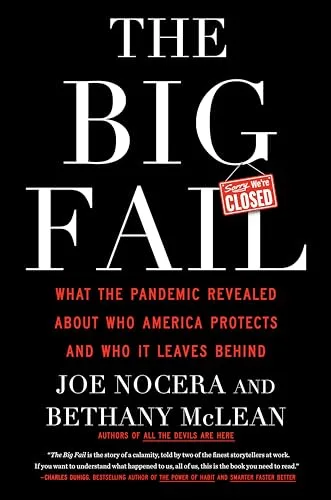
The Big Fail
What the Pandemic Revealed About Who America Protects and Who It Leaves Behind
by Joe Nocera and Bethany McLean
- Published
- 2023
- Pages
- 448 pages
- Publisher
- Portfolio
- Readers
- 0 members have read this
The authors of *All the Devils Are Here* turn their 2008 method on Covid, tracing America's failures to decisions made long before 2020: offshored supply chains, hospitals run for margin and private equity in nursing homes. Finance readers will recognize the pattern of efficiency that leaves no slack for a shock.
The pandemic, in this telling, exposed choices American capitalism had already made. Trade deals such as NAFTA pushed supply chains abroad, so by 2020 hospitals bought protective gear from China as needed, with few domestic alternatives. Hospital chains, industrialized since Nashville internist Tommy Frist Sr. began franchising them in the late 1960s, had cut beds to protect margins. Private equity owned many of the nursing homes where staff shortages proved deadly. Then politics took over.
McLean, a Vanity Fair writer and former Fortune editor at large who spent three years at Goldman Sachs, co-wrote The Smartest Guys in the Room on Enron. Nocera, a veteran New York Times columnist, has won three Gerald Loeb Awards. Their 2010 book on the mortgage crisis, All the Devils Are Here, is one of the standard accounts of 2008, and this book applies the same chain-of-causation approach.
It is also openly contrarian on public health policy. The authors give a sympathetic hearing to scientists sidelined for questioning lockdowns, contrast the approaches of Andrew Cuomo and Ron DeSantis, and treat school closures as among the worst mistakes. They praise Operation Warp Speed as the clear success. Alex Tabarrok, who endorsed much of the argument, disputed the private equity chapter, citing studies in which buyout-owned nursing homes did about as well as others and community spread mattered most.
Read it for the supply chain and health care economics, and for a model of how to trace a crisis back to incentives set years earlier.
- Efficiency removes slack. Just-in-time purchasing of protective gear saved money for years and failed all at once when every buyer needed it at the same time.
- Ownership structure shapes outcomes. The authors tie hospital bed cuts and nursing home staffing to owners focused on margins and debt service, though critics say the evidence on private equity is mixed.
- Look for the long fuse. Like 2008, the pandemic's damage traced to decisions made decades earlier, which is where an analyst should look before the next shock.
- Public-private deals can work. Operation Warp Speed showed that government working closely with drugmakers, under firm leadership, can sharply accelerate development and distribution.
- Consensus is not proof. The book's account of how dissent was shut down is a warning to any investment committee that mistakes agreement for analysis.
Reviews describe a book that moves from long-run causes to the crisis itself and then to the policy fights it set off.
- The setup. Decades of globalized sourcing, hospital consolidation and buyout ownership of nursing homes leave the system efficient in normal times and brittle in a crisis.
- The arrival. The Trump administration's task force focuses on bringing Americans home from China, testing lags, and hospitals scramble for masks and ventilators amid a black market and outright fraud.
- Who died. Overflowing hospitals, struggling safety-net institutions and understaffed nursing homes, with outcomes sharply divided by race, insurance, income and age.
- The politics. Cuomo and DeSantis as opposite case studies, shifting mask guidance, lockdowns that favored big-box chains over small shops, dissenting scientists cast as fringe, and school closures.
- Vaccines and the reckoning. Operation Warp Speed as a public-private success, followed by overselling and rushed booster decisions, and the authors' call for a full public accounting that has yet to happen.
Reader reviews
No reviews yet. Join to write the first one.