
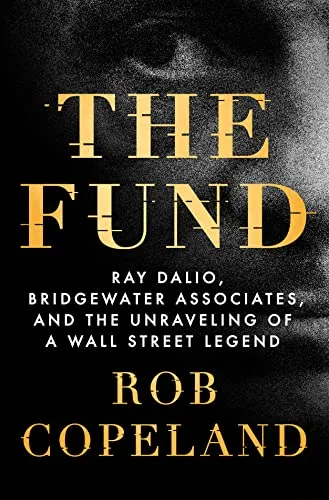
The Fund
Ray Dalio, Bridgewater Associates, and the Unraveling of a Wall Street Legend
by Rob Copeland
- Published
- 2023
- Pages
- 352 pages
- Publisher
- St. Martin's Press
- Readers
- 0 members have read this
Rob Copeland's unauthorized history of Bridgewater Associates argues that the world's largest hedge fund ran less on Ray Dalio's celebrated rules-based machine than on Dalio's own instincts, with radical transparency working as a tool of control. Read it to see how far a manager's story about its process can drift from the process itself.
Ray Dalio founded Bridgewater Associates in his Manhattan apartment in 1975, built it into the world's largest hedge fund firm and turned his management creed into the bestseller Principles. Copeland's account turns that image inside out. Drawing on hundreds of interviews, internal documents and leaked emails, he portrays a firm steered largely by Dalio's own calls, including recession forecasts that failed to arrive and led to losing trades, and a culture in which staff rated one another's believability, meetings were recorded and replayed, and the founder could berate employees in public.
Copeland covered hedge funds for The Wall Street Journal, where a 2020 profile showed Dalio reluctant to give up control, before moving to The New York Times. Around publication he also reported for the Times that Bridgewater's investing leaned heavily on Dalio's personal views and on his contacts with senior government officials, not on the systematic engine clients had been sold.
The book became a New York Times bestseller and drew a furious response. Dalio called it fiction presented as fact and a sensational tabloid, and Bridgewater called it a false and misleading account of its past. Copeland says neither offered a substantive factual rebuttal, and he discloses in the book that he once interviewed at the firm. Readers should also know that it spends far more time on management dysfunction than on a forensic analysis of investment returns.
Read it alongside Principles. It is most useful for allocators doing diligence on star managers, for anyone weighing key-person and succession risk, and for executives tempted to treat culture as a marketing asset.
- Diligence the process, not the pitch. Bridgewater marketed a systematic, rules-driven engine, yet Copeland reports that the founder's personal calls drove much of the investing. Allocators should test how decisions are actually made, not how they are described.
- Key-person risk can hide inside a system. A firm that presents itself as a machine can still depend on one person's judgment, and that dependence often shows only when succession is attempted.
- Feedback tools can become control tools. Believability scores, recorded meetings and public critiques were sold as meritocracy; in Copeland's telling they concentrated power and bred fear. Watch how such systems are used, not how they are framed.
- Succession is a strategy problem. Dalio's long, halting exit, which ended with his transfer of voting control to the board in 2022, shows how hard it is to institutionalize a founder-led investment firm.
- Weigh contested accounts. Dalio and Bridgewater reject the book outright. Read it next to Principles and decide for yourself where the two stories diverge.
Copeland moves chronologically through roughly five decades of Dalio's leadership, ending with the founder's 2022 handover.
- Founding and rise. Dalio starts Bridgewater from his Manhattan apartment in 1975 and builds it into the largest hedge fund firm in the world, with a reputation as a macro investor who runs on a system rather than gut feel.
- The Principles machine. Dalio's rules become a management regime of radical transparency: employees grade one another's believability, new hires list their weaknesses, and recorded meetings are reviewed for errant thinking.
- Celebrity. Dalio becomes a media fixture, and the bestselling Principles turns Bridgewater's internal code into a public brand.
- The investing question. Copeland examines how decisions were actually made, arguing that Dalio's own judgment, including recession calls that did not pan out, mattered more than the vaunted machine.
- Succession and exit. Plans to hand the firm to a new generation repeatedly falter until Dalio transfers his voting control to the board in October 2022, leaving open whether Principles can outlast its author.
Reader reviews
No reviews yet. Join to write the first one.