
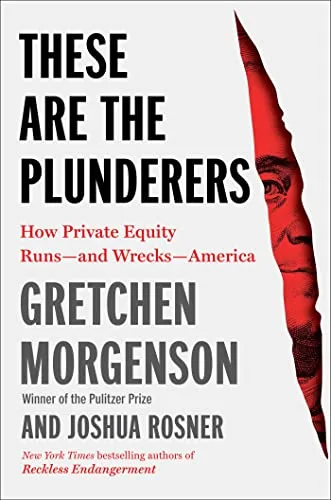
These Are the Plunderers
How Private Equity Runs—and Wrecks—America
by Gretchen Morgenson and Joshua Rosner
- Published
- 2023
- Pages
- 400 pages
- Publisher
- Simon & Schuster
- Readers
- 0 members have read this
A prosecutorial case against the buyout industry, built on Apollo and Leon Black's takeover of the failed insurer Executive Life and a long run of deals at nursing homes, hospitals and retailers. Anyone who works with private equity, or invests alongside it through a pension, should know the argument, the fee mechanics and the political risk it describes.
Private equity, in this account, mostly builds nothing: firms borrow to buy companies, load them with debt, pull out fees and cash and leave workers, customers and communities to absorb the damage. Gretchen Morgenson and Joshua Rosner spend much of the book on Apollo and its cofounder Leon Black, starting with the 1991 collapse of Executive Life, the California insurer stuffed with Drexel junk bonds, whose portfolio Black's group bought cheaply while policyholders took losses. Blackstone, KKR and Carlyle also get extended attention.
Morgenson won a Pulitzer Prize in 2002, worked as a stockbroker and reported for the Wall Street Journal and the New York Times before joining NBC News. Rosner is a Wall Street research veteran at Graham Fisher & Co. Their first collaboration, Reckless Endangerment, covered the 2008 financial crisis. Here they draw on court filings, hearings, academic studies and interviews across 17 chapters and more than 50 pages of notes.
The case studies land hard: Apollo's 2007 purchase of the Noranda aluminum smelter in New Madrid, Missouri, which later shut under its debt; nursing homes and hospitals that cut staff during Covid; Blackstone's reported funding of an ad campaign against limits on surprise medical bills. The book is openly one-sided. CFA Institute's reviewer asked whether the worst cases were cherry-picked, and the Washington Independent Review of Books noted that the authors assume targets were healthy before the buyout, ignore successful turnarounds and stretch the subtitle for an industry whose companies employ about 7 percent of US workers.
Read it as the strongest version of the critics' brief, which is exactly the version regulators and politicians are reading.
- Follow the fees. The authors show how much of the industry's profit comes from management, monitoring and transaction fees that pay out regardless of how portfolio companies perform.
- Leverage shifts risk to others. At Noranda and elsewhere, debt raised to pay owners left the company itself, and its workers and town, holding the downside.
- Insurance balance sheets are a prize. The Executive Life saga, and the industry's later push into insurers, show why policyholder money attracts buyout firms and why that creates conflicts.
- Health care is the political flashpoint. Nursing homes and hospitals are where critics found the most damaging evidence, and where bipartisan scrutiny has gathered, as at the 2021 Senate hearing.
- Read the counterarguments too. Reviewers note the book omits successful deals and questions about whether targets were healthy to begin with, so pair it with the industry's own data before drawing conclusions.
The book opens with origins and a single long case before widening into a survey of the industry's methods and its reach in Washington.
- Junk bonds and the first buyouts. A short history of Michael Milken, Drexel Burnham Lambert and the leveraged buyout sets out the tools the industry still uses.
- Executive Life. The first half centers on the insurer's 1991 failure, Insurance Commissioner John Garamendi's seizure and the sale of its bond portfolio to Black's group, told partly through policyholders who lost promised annuity income.
- The playbook. Debt-funded purchases, fees that keep flowing after a company is sold, fees on committed but uninvested capital and sales to sister funds, illustrated with Noranda, Toys R Us, Neiman Marcus and others.
- Health care. Nursing homes, hospitals and emergency-room operators owned by buyout funds, with accounts of staff cuts during the pandemic, unnecessary care billed to Medicare and ownership structures that skirt state limits on corporate medicine.
- Power and pushback. Carlyle's hiring of former officials such as George H.W. Bush and James Baker, opaque ownership structures, a 2021 Senate hearing where Richard Blumenthal and Josh Hawley both criticized the industry, and SEC chair Gary Gensler's push for new disclosure rules.
Reader reviews
No reviews yet. Join to write the first one.