
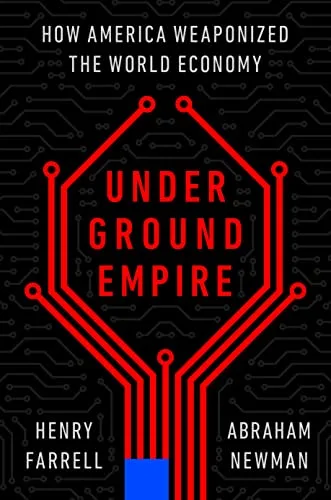
Underground Empire
How America Weaponized the World Economy
by Henry Farrell and Abraham Newman
- Published
- 2023
- Pages
- 288 pages
- Publisher
- Henry Holt
- Readers
- 0 members have read this
Two political scientists explain how the plumbing of globalization, from dollar clearing and SWIFT messaging to undersea cables and chip supply chains, became a tool of American coercion. For anyone who trades, lends or does compliance across borders, it explains why sanctions risk now sits in every deal and why rivals are racing to build workarounds.
The world economy is not flat, Farrell and Newman argue. It is full of chokepoints, and the United States sits on most of them. Private companies built the networks that globalization runs on for profit: Citibank and other dollar-clearing banks, the Belgian payments cooperative SWIFT, the fiber-optic hubs around Ashburn, Virginia, and the chip supply chains that run through TSMC. After September 11, Washington learned it could use those hubs to watch and to punish. The book follows that discovery from counterterrorism to Iran, North Korea, Huawei and Russia, and argues that the result is an improvised empire nobody designed.
Farrell is the SNF Agora Professor of International Affairs at Johns Hopkins SAIS; Newman teaches at Georgetown's School of Foreign Service. They coined the phrase weaponized interdependence in a 2019 academic article, and this book turns that theory into narrative. It won a bronze medal in the Council on Foreign Relations' Arthur Ross Book Award and was shortlisted for the Lionel Gelber Prize.
Reviewers praised how clearly it explains obscure financial and digital infrastructure; Publishers Weekly gave it a starred review. Krzysztof Pelc, writing in the Los Angeles Review of Books, countered that it sometimes overstates the state's control over companies that bargain hard for their cooperation, and that this power is hard to separate from ordinary diplomacy. Wesley Clark noted that it leaves out tools such as phone tracking, blockchain tracing and the Federal Reserve's reach.
Read it with Chris Miller's Chip War for the semiconductor side. It belongs on the desk of anyone in sanctions compliance, correspondent banking, FX or geopolitical risk.
- Infrastructure is leverage. Whoever controls the hubs of a network, such as dollar clearing, payment messaging or cable landing points, can see and block what flows through it. Ask who sits at the center of any system your business depends on.
- Dollar access is a privilege, not a utility. Because almost every cross-border dollar payment touches a U.S. bank, Washington can cut off a target without the cooperation of the target's own government.
- Sanctions reach far beyond the target. Banks and companies over-comply out of fear of secondary penalties, so the practical reach of U.S. policy is wider than the legal text.
- Private networks become state tools. Firms built these systems to make money, but once the government learned to use them, companies like SWIFT, HSBC and TSMC were pulled into geopolitics whether they liked it or not.
- Every use invites a workaround. Freezing Russia's reserves and cutting off Huawei pushed rivals and some allies toward alternative payment systems and domestic chip supply, slowly eroding the leverage itself.
The book is told as a history, moving from the private construction of global networks to their conversion into weapons and the backlash that followed.
- Building the hubs. Starting in the 1970s, banks led by Citibank built the dollar-clearing system and SWIFT standardized payment messages, while telecom firms laid fiber that routed much of the world's internet traffic through U.S. territory.
- The post-9/11 turn. Intelligence agencies tapped cable landing points the NSA treated as chokepoints, and the Treasury gained access to SWIFT data after learning the hijackers' money had moved through it.
- Squeezing Iran and North Korea. Sanctions moved from terrorists to states. Iranian banks were cut off from SWIFT in 2012, readmitted under the 2016 nuclear deal and cut off again after the 2018 U.S. withdrawal, and Europe's attempt at a workaround failed. In 2019 a State Department official threatened a tanker captain carrying Iranian oil with personal sanctions.
- Huawei and the chip war. Bank records from HSBC fed the case that led to the arrest of Huawei's Meng Wanzhou in Vancouver, and U.S. pressure cut Huawei off from TSMC's advanced chips before export controls widened to China as a whole.
- Russia and the backlash. After the 2022 invasion of Ukraine, Russian banks were removed from SWIFT and central bank reserves were frozen. The authors close on the costs: lost trust, allies and rivals hunting for alternatives, and the risk of an arms race in economic coercion.
Reader reviews
No reviews yet. Join to write the first one.