
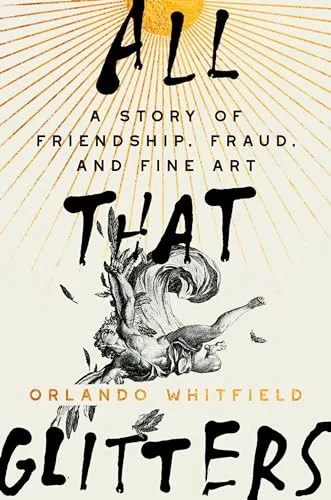
All That Glitters
A Story of Friendship, Fraud, and Fine Art
- Published
- 2024
- Pages
- 336 pages
- Publisher
- Pantheon
- Readers
- 0 members have read this
A former dealer's memoir of his friend Inigo Philbrick, the London and Miami art dealer jailed for an $86 million fraud, doubles as a field guide to art as a financial asset. It shows how fractional stakes, art-backed loans and private resales let one dealer sell more than 100 percent of a painting, and why an opaque, lightly regulated market let him do it for years.
Orlando Whitfield and Inigo Philbrick met at Goldsmiths, University of London, in 2006 and started dealing art together as students. Philbrick went on to a place on White Cube's acquisitions committee under Jay Jopling, then built his own secondary-market business with galleries in London and Miami, trading works by Rudolf Stingel, Christopher Wool and Wade Guyton as trading positions. By 2019 he had sold stakes in some works that added up to more than 100 percent, pledged art he did not fully own as loan collateral, and forged paperwork, including a fake $9 million Christie's guarantee. He fled to Vanuatu, was arrested by the FBI in June 2020, pleaded guilty to wire fraud and in May 2022 received a seven-year sentence.
Whitfield spent about 15 years dealing in and around the market, worked for a stretch inside one of Philbrick's ventures, and reconstructs the later schemes from emails, spreadsheets and court records, many of them sent to him by Philbrick. It is his first book. He casts himself as Nick Carraway to Philbrick's Gatsby, and The Economist likened it to a Liar's Poker for the art world.
What sets it apart from news coverage of the case is the inside view of the friendship and the deal flow. Kirkus credits Whitfield with indicting the system as well as the man: no real regulation, private pricing, and collectors who use art as a portable store of wealth kept in Swiss storage. The book was shortlisted for the 2024 Nero Book Awards.
Critics flagged real limits. The London Review of Books found the tone torn between fascination and condemnation and judged Whitfield too credulous about where his friend's money came from; The Washington Post doubted his claims of naivety. Read it if you invest in, lend against or diligence illiquid alternative assets.
- Title is the weak link. Art has no central ownership registry, which let Philbrick sell shares in a single canvas that added up to more than 100 percent. Any asset traded privately needs independent proof of who owns what.
- Collateral needs verification, not trust. He pledged works he did not fully own as security for loans, and co-owners did not know. Lenders against art, or any illiquid asset, must confirm title and every existing lien.
- Fake price signals are cheap to make. An invented buyer, a forged $9 million Christie's guarantee and arranged bidders all propped up marks. A hard sale at $5.5 million exposed the gap between claimed and real value.
- Leverage requires rising prices. The scheme worked only while new sales and loans could repay old ones; a missed market price and a defaulted $14 million loan in late 2019 ended it, the pattern of every leveraged fraud.
- Opacity serves insiders. Whitfield shows that the art world's prized discretion also shields bad actors, and that participants have reasons to stay quiet. Treat secrecy around pricing as a risk factor, not a mark of exclusivity.
The book runs roughly chronologically, with Whitfield's own unraveling told alongside Philbrick's rise and fall.
- Goldsmiths and first deals. The two meet in 2006, chase small trades together (including failed bids for Banksy works cut from London buildings) and set up as dealers while still students.
- The White Cube years. Philbrick attaches himself to Jay Jopling and White Cube's Modern Collections, becomes a star secondary-market dealer in his early twenties, and opens his own galleries in London and later Miami. Whitfield's career stalls by comparison and their partnership turns tense.
- Flipping and leverage. Whitfield works for a time in Philbrick's orbit as the business shifts to fractional stakes, flipped works and art-backed loans, while his own gallery fails and he suffers a breakdown; a chapter on restoring prints in a Camberwell studio offers a refuge.
- The collapse. The schemes come into view: an invented buyer, a Stingel portrait of Picasso sold to several parties, a forged auction guarantee, and a May 2019 sale at $5.5 million that could not cover the stakes outstanding.
- Flight and reckoning. Philbrick vanishes in late 2019, emails Whitfield from Vanuatu, is arrested in June 2020 and is sentenced in New York, leaving Whitfield to sort friendship from complicity.
Reader reviews
No reviews yet. Join to write the first one.