
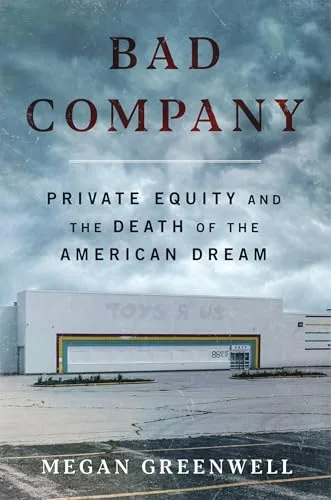
Bad Company
Private Equity and the Death of the American Dream
- Published
- 2025
- Pages
- 320 pages
- Publisher
- Dey Street
- Readers
- 0 members have read this
A former Deadspin editor follows four people whose jobs, hospital, newspaper and home were reshaped by private equity owners. Greenwell shows the leveraged buyout from the receiving end: debt loaded onto the target, costs cut, assets sold and the risk pushed onto workers, patients and tenants. Anyone who models, finances or sells to PE-backed companies should read it.
Private equity firms now own hospitals, day care centers, grocery chains, newspapers, nursing homes and apartment complexes, yet most people barely know how the industry works. Megan Greenwell explains it in plain terms. A firm pools money from pension funds, endowments and wealthy investors, borrows heavily, and puts the debt on the company it buys rather than on itself. The firm's downside is limited. Workers, patients and tenants absorb most of the rest.
Greenwell came to the subject the hard way. She was editor in chief of Deadspin when a Boston-based private equity firm bought the site in 2019, quit after three months of decisions she considered self-defeating, and watched her staff follow. Before that she wrote or edited for WIRED, New York Magazine, ESPN, The New York Times and The Washington Post. She interviewed well over a hundred people before choosing four to carry the book.
The method is closer to Matthew Desmond's Evicted than to Barbarians at the Gate. Earlier deal books told the story from the boardroom. This one starts on the shop floor and in the exam room, and it treats Bain Capital, Apollo Global Management and their peers as forces acting on ordinary lives. Kirkus called it effective and humane, and the AP praised its reporting and pace.
It is an argument, not a balance sheet. Greenwell does not weigh fund returns, the case for operational improvement, or deals that worked. Her point is that PE usually exploits industries that were already weak rather than breaking them. Bankers, LPs, pension trustees and analysts covering PE-owned issuers should read it to understand the political and reputational risk building around the asset class.
- The debt sits with the target. In a leveraged buyout the loans go on the acquired company's balance sheet, so the sponsor can profit even when the business later fails.
- Toys R Us is the template. A heavily indebted retailer was squeezed for years and then liquidated, and frontline workers were the last creditors in line, without severance.
- PE has moved into recession-proof sectors. Health care, housing and local news offer steady cash flows, and when services are cut the damage falls on patients, tenants and readers.
- LP money makes it possible. Pension funds and endowments supply much of the equity, so the workers hurt by these deals may be funding them through their own retirement plans.
- Political risk is rising. Greenwell finds organized resistance from tenants, doctors and journalists, and she sets out policy ideas that investors in the asset class should take seriously.
The book opens with Greenwell's own Deadspin experience and a primer on the leveraged buyout. It then follows four people, each standing for an industry where private equity has spread, before ending with those who are pushing back.
- The playbook. How firms raise capital from pension funds and endowments, add bank debt, and assign that debt to the acquired company. Why their own exposure stays small, and how donations to both parties have kept regulation light.
- Retail. Liz, a Toys R Us floor supervisor in Oregon, takes on the work of three people after the 2005 buyout that included Bain Capital. The chain fails in 2017, and some 33,000 workers lose their jobs without severance.
- Health care. Roger, a doctor in rural Wyoming, watches services at his hospital cut under Apollo Global Management ownership. He then helps open a new hospital to fill the gap.
- Local news. Natalia, an immigrant who became a reporter at Gannett's local papers, works through years of cuts that remove more than half the chain's staff.
- Housing. Loren, an affordable-housing organizer, moves into a mold- and rodent-infested complex in northern Virginia owned by a distant private equity landlord. She presses for repairs and is evicted on a doubtful pretext.
- Fighting back. Her subjects lobby officials and pension funds and organize their communities. Greenwell proposes rules that would make a firm earn its profit by keeping a company running rather than by stripping it.
Reader reviews
No reviews yet. Join to write the first one.