
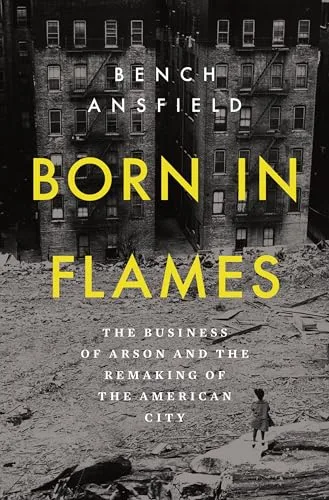
Born in Flames
The Business of Arson and the Remaking of the American City
- Published
- 2025
- Pages
- 352 pages
- Publisher
- W. W. Norton
- Readers
- 0 members have read this
The 1970s arson wave that burned the Bronx is usually blamed on tenants. Historian Bench Ansfield follows the money instead: insurance priced and sold so badly that a building could be worth more burned than standing. It is a sharp study of moral hazard, mispriced risk and an insurance industry that made its money investing premiums, with lessons for today's climate-risk insurance markets.
Across the 1970s, fires destroyed whole neighborhoods in American cities; the Bronx lost about a fifth of its housing stock. Ansfield argues the most destructive fires were set not by residents but by landlords collecting insurance, often through hired torches. The book explains the incentives that made this rational.
The financial plumbing is the heart of it. After the 1960s uprisings, insurers already retreating to the suburbs pulled further out of cities, and Lloyd's of London withdrew reinsurance. The federal response, shaped by the Hughes Panel, created state FAIR plans: public-private pools that gave access to coverage on punishing terms, a practice Ansfield calls brownlining. Rates set only on the pool's own losses ran several times the voluntary market, while policies insured buildings for far more than they could sell for. Insurers earned much of their profit investing premiums in stocks, bonds and money markets, so losses on a few buildings barely registered. Later, excess and surplus lines carriers with thin oversight filled the gap, and arson rings tied landlords, agents, adjusters and underwriters together.
Ansfield, an assistant professor of history at Temple University with a Yale PhD, built the book on a decade of research; the underlying dissertation won the Allan Nevins Prize. The book was a 2026 Pulitzer Prize finalist in history and won the Los Angeles Times Book Prize for history.
The caveats are modest. Reviewers praised it almost without reservation; Protean's reviewer noted that Ansfield is careful not to overstate what tenant organizing achieved. Read it for one of the clearest accounts of how badly designed insurance can destroy the assets it covers.
- Overinsurance creates arsonists. When the insured value of a building exceeds its market value, destroying it becomes the profitable trade; moral hazard is a design problem, not just a character flaw.
- Insurers are investment firms. In the high-rate 1970s, investment income on premiums mattered more to insurers than underwriting losses, which dulled their interest in what they insured.
- Public backstops can misprice risk. FAIR plans meant to repair redlining charged punishing rates yet still enabled fraud, a warning for any state-run insurer of last resort.
- Watch the thinly regulated corners. Excess and surplus lines carriers with weak oversight became the conduit for organized fraud rings.
- Data can catch fraud. New York's Arson Strike Force used predictive risk scoring to target likely arsons, an early example of analytics in fraud detection.
The book runs in two broad movements: how the market for urban fire insurance produced arson for profit, and how tenants, prosecutors and eventually the industry brought it to an end.
- A racially tiered market. After the 1945 McCarran-Ferguson Act left insurance to state regulators, insurers built profitable packages for suburban homes and redlined or overcharged urban neighborhoods.
- Uprisings and retreat. The 1960s rebellions in Detroit, Newark and Los Angeles prompted a panic over losses, Lloyd's pulled reinsurance and insurers accelerated their exit from cities.
- The FAIR bargain. The Hughes Panel traded federal reinsurance for an end to redlining and created FAIR plans, whose pricing and loose underwriting left buildings insured above market value.
- The burning years. Landlords hired torches, one ring burned some 250 buildings, and tenants slept in their shoes while officials blamed residents and welfare fraud.
- Fighting back. Tenant organizers such as Genevieve Brooks, prosecutors, some insurers and New York's 1978 Arson Strike Force, with its arson risk index, finally broke the pattern.
- The legacy. Ansfield links the story to today's insurance retreat from areas most exposed to climate shocks.
Reader reviews
No reviews yet. Join to write the first one.