
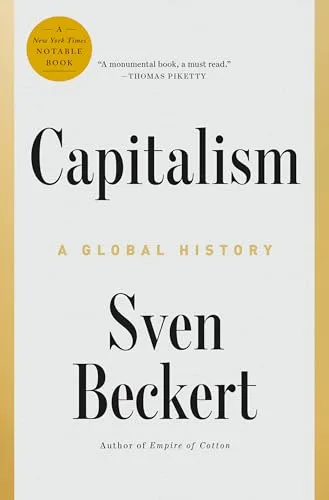
Capitalism
A Global History
by Sven Beckert
- Published
- 2025
- Pages
- 1,344 pages
- Publisher
- Penguin Press
- Readers
- 0 members have read this
Harvard historian Sven Beckert, author of Empire of Cotton, tells the thousand-year history of capitalism from twelfth-century merchants in Aden to Cambodian garment factories. His argument is that capitalism was global from the start and built by states, coercion and empire as much as by markets. A long but rewarding history of where capital and finance came from.
Beckert defines capitalism as an economic logic centered less on markets than on the growth of capital, meaning money and goods put to work to make more money. His 1,344-page history follows that logic across a millennium and six continents of archives, from merchant houses in Aden to car factories in Turin, sugar plantations in Barbados and textile mills in today's Cambodia.
The central claim is that capitalism was born global. It grew slowly from trading communities across Asia, Africa and Europe, then exploded when European states and merchants joined forces overseas. Beckert calls this modern capitalism's big bang, with the slave labor camps of the Caribbean as one of its epicenters and the launch pad for the Industrial Revolution. At no point, he argues, did the system resemble an idealized free market; state-backed institutions and imperial expansion shaped it throughout.
Beckert is the Laird Bell Professor of History at Harvard, where he co-directs the Program on the Study of Capitalism. Empire of Cotton won the Bancroft Prize and was a Pulitzer finalist. Capitalism was a New York Times Notable Book and a Financial Times Best Book of the Year; John Kay, reviewing for the FT, valued it as a reference work.
The obvious caveat is size: Kirkus called it sprawling, and few readers will go straight through. The book's skepticism of free-market accounts will also draw argument, which Marcus Rediker in the New York Times expected. For finance readers, it supplies the long history behind double-entry bookkeeping, paper money, credit and the recurring cycle of booms and busts.
- Capital is a process, not a place. Beckert rejects single origin stories such as Florence, Amsterdam or Manchester, showing capitalism emerging from many trading hubs over centuries.
- Merchants were the first capitalists. Long-distance traders like those in twelfth-century Aden, managing goods and credit from afar, set out the logic of reinvested capital.
- States built markets. State power, imperial expansion and state-backed institutions shaped capitalism at every stage, a useful corrective for anyone who assumes markets arise on their own.
- Coercion financed growth. Slavery and forced labor supplied capital and commodities for industrialization, part of the true history behind early modern finance.
- The system keeps mutating. Capitalism has coexisted with democracies and dictatorships alike, so investors should expect new combinations of state and capital rather than a fixed model.
The book runs chronologically, opening with a chapter titled Islands of Capital.
- Islands of capital. Around 1150, a new kind of merchant in the port of Aden managed trade at a distance rather than traveling with goods. Similar islands of capital appeared in trading communities across Asia, Africa and Europe.
- The big bang. Mercantilism, double-entry bookkeeping and paper money take hold as European states and merchants project power across the oceans; Caribbean slave plantations become an engine of capital accumulation.
- Industrial capitalism. Coal, oil and huge productivity gains drive the Industrial Revolution, and by the mid-nineteenth century capitalism has reorganized the world economy, bringing recurring panics, booms and busts.
- Revolts and war. A century of rebellion and large-scale war follows the global reorganization.
- The golden age and decolonization. After World War II comes a managerial, bureaucratic golden age, and a new international order that favors the free movement of capital over the claims of newly independent states.
- The present and after. Markets reach into new realms, including attention, alongside extreme inequality and environmental cost; Beckert closes by arguing that capitalism, a recent invention, will keep changing.
Reader reviews
No reviews yet. Join to write the first one.