
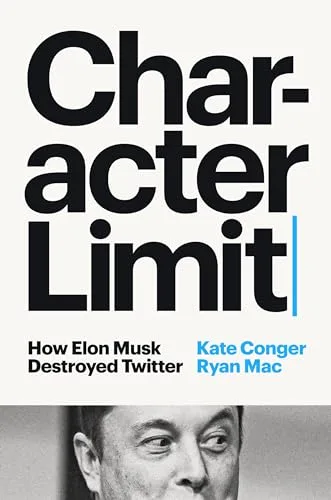
Character Limit
How Elon Musk Destroyed Twitter
by Kate Conger and Ryan Mac
- Published
- 2024
- Pages
- 480 pages
- Publisher
- Penguin Press
- Readers
- 0 members have read this
A reported account of the messiest leveraged buyout in recent memory: Elon Musk's $44 billion purchase of Twitter, his attempt to walk away, the lawsuit that forced him to close, and the fallout. Deal people will see what happens when a buyer with heavy bank debt, no clear business plan and motives that have little to do with returns takes over an advertising-funded company.
Two New York Times technology reporters trace Twitter from Jack Dorsey's era through Elon Musk's 2022 takeover and the company's conversion into X. Their central judgment is that Musk bought the platform for himself, as an ideological project rather than an investment, and that its finances paid the price. The account rests on interviews, internal documents and recordings from inside the company.
Kate Conger covers X and Musk for the Times. Ryan Mac spent more than a decade reporting on wealth and power in Silicon Valley at Forbes and BuzzFeed News, where his Facebook coverage won a 2019 Mirror Award and a 2020 George Polk Award. Both covered the deal as it happened.
The finance story is the reason to read it here. The $54.20-a-share deal was backed by about $13 billion of bank loans in a group led by Morgan Stanley and by equity from co-investors such as Larry Ellison and Prince Alwaleed bin Talal. Musk then tried to terminate in July 2022, and Twitter sued him in the Delaware Court of Chancery. The Washington Post's reviewer said the book answers many questions about both the financing and Musk's motives. The aftermath is stark: Conger has said the debt costs roughly $1 billion a year in interest, and by the time the book appeared Fidelity had marked the company near $12 billion.
It is longer and better sourced than Ben Mezrich's Breaking Twitter, which used recreated dialogue and composite characters. Reviewers note that it sprawls, and Lawfare's Katie Harbath found it too clinical about the toll on employees. Read it for M&A, leveraged finance and governance lessons.
- A signed merger agreement binds even the richest buyer. Musk's July 2022 attempt to terminate ended when Twitter's board sued in Delaware's Court of Chancery and he closed at the original $54.20 a share. Sellers with a tight contract hold the cards when buyer's remorse sets in.
- Leverage fits poorly on a company that barely profits. Twitter was already struggling to make money when the buyout loaded it with roughly $1 billion a year in interest. That made drastic cost cuts unavoidable before any new strategy existed.
- Advertiser revenue depends on trust. Moderation reversals and the verification overhaul drove advertisers away, a direct hit to the revenue that had to service the debt.
- Watch the marks. Musk paid $44 billion; by the book's publication his own internal valuation was about $19 billion and Fidelity's mark was near $12 billion. Few buyouts have destroyed value so fast.
- Underwrite the buyer's motive. The authors argue Musk wanted the platform as a political tool and cared little about its finances. Lenders and co-investors backing a single, mercurial owner took on key-person risk that no covenant could control.
The book runs roughly chronologically in three acts, opening on the night in late October 2022 when the deal closed at Twitter's San Francisco headquarters.
- Before the offer. Twitter under Jack Dorsey, who served two stints as CEO and left disillusioned after an earlier takeover push, and his courtship of Musk. Successor Parag Agrawal plans deep layoffs to fix delayed profitability, until Musk builds a stake, floats a board seat and then bids for the whole company.
- The deal and the escape attempt. The board accepts Musk's offer, Musk tries to back out, and the board sues to hold him to the agreement. Employee hopes that he would be a capable technocrat-owner fade, and he closes at the original price.
- Twitter becomes X. Thousands are laid off, janitorial staff are cut so deeply that employees bring their own toilet paper, verification is overhauled before the midterms and advertisers leave. By 2023 the company is so thin it is close to breaking, and Linda Yaccarino is hired as CEO.
- The political turn. The closing chapters follow Musk's radicalization, and the epilogue's account of his rekindled relationship with Donald Trump, ending on the authors' conclusion that Musk bought Twitter for himself.
Reader reviews
No reviews yet. Join to write the first one.