
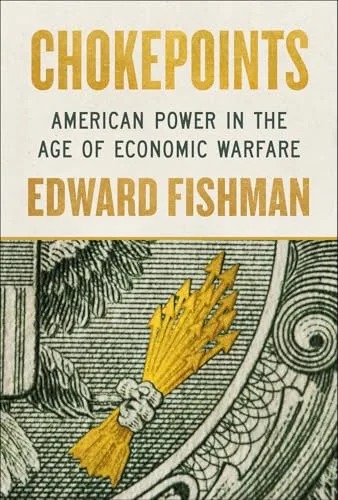
Chokepoints
American Power in the Age of Economic Warfare
- Published
- 2025
- Pages
- 560 pages
- Publisher
- Portfolio
- Readers
- 0 members have read this
A former US sanctions official shows how Washington learned to turn the dollar, SWIFT, chips and London shipping insurance into weapons against Iran, Russia and China. For bankers, compliance teams and macro investors, it is the clearest account of how modern economic warfare works, and of why sanctions risk is now market risk.
Edward Fishman's subject is how US officials, starting around 2006, learned to find and squeeze chokepoints: goods and services that other countries need and that America or its close allies control. Treasury officials warned European banks about the Iranian money moving through them. Under threat of US secondary sanctions, Iranian banks were cut off from SWIFT in 2012, and Iran's oil revenue was locked in accounts abroad. The same tools later hit Russia after Crimea, Chinese firms such as ZTE and Huawei, and Russia again in 2022, when Western insurers and an oil price cap became weapons.
Fishman worked on these campaigns. He served at Treasury, on the State Department's Iran sanctions team and at the Pentagon. After the Crimea annexation he became the first Russia and Europe lead in State's sanctions policy office, and he was on the Policy Planning Staff from 2015 to 2017. He now directs the Council on Foreign Relations' Maurice R. Greenberg Center for Geoeconomics. Each part centers on one official, which gives the book a fly-on-the-wall feel.
It carries the chokepoint idea from Chris Miller's Chip War into finance and energy. It was a finalist for the 2025 Financial Times Business Book of the Year and made best-of-year lists at The Economist, the FT, Bloomberg and NPR. Reviewers flagged real limits. William Allen of NIESR noted that Fishman left government in 2017 and cannot explain the 2018 US exit from the Iran deal. He also said it skips central banks' gold buying and doubted that chokepoint tactics work over the long run against big adversaries. Fishman concedes that sanctions invite evasion, are hard to unwind and push targets toward alternatives.
Read it if you work in bank compliance, trade finance, commodities or emerging markets.
- A chokepoint is control without substitutes. Leverage comes from owning something others cannot quickly replace, such as dollar clearing, SWIFT access, advanced chips or marine insurance.
- Banks are the enforcement arm. The Iran campaign worked because global banks feared US penalties more than they valued Iranian business. For financial firms, compliance exposure is geopolitical exposure.
- Services can be weapons too. Russian tankers stalled at the Bosphorus for lack of London insurance. Insurers, payment networks and clearing houses can be turned against a country as surely as chip exports.
- Sanctions are easy to impose and hard to lift. After the 2015 Iran deal, Washington struggled to find a bank willing to handle Iranian transactions, and ZTE showed how fast a company can be shut down and revived. Price that persistence into any sanctioned name.
- Each use wears down the weapon. Targets build workarounds, from a China-Russia swap line to alternative payment systems. Fishman warns that the biggest risk to the dollar's leverage may be erosion of US institutions, including the Fed's independence.
After an introduction, the book runs chronologically through six parts and closes with a conclusion titled Impossible Trinity.
- Building the chokepoints. A short history of economic war from Pericles to Saddam Hussein, and how dollar dominance and the hidden plumbing of global finance created leverage Washington could use.
- Iran and the bomb. Stuart Levey's Treasury campaign pressures foreign banks, Iran is cut off from SWIFT, its oil money is frozen abroad, and sanctions relief under the 2015 nuclear deal proves hard to deliver.
- Russia's imperial land grab. After Euromaidan and Crimea, Washington and Brussels design targeted sanctions. The downing of MH17 hardens Europe's position and Russia's economy is battered.
- China's bid for technological mastery. Export controls and denial orders against ZTE, Fujian Jinhua and Huawei. ZTE nearly collapses within weeks and is then reprieved after Xi Jinping appeals to Donald Trump.
- Russia's invasion of Ukraine. The 2022 sanctions campaign, Germany's turn, pressure on the ruble and the fight over Russian oil revenue, enforced through Western shipping and insurance services.
- The world economic rupture. Narrowly targeted tech controls, the global scramble for economic security and efforts by rivals to break America's chokepoints. Fishman closes with a call to treat economic statecraft as a permanent part of national security.
Reader reviews
No reviews yet. Join to write the first one.