
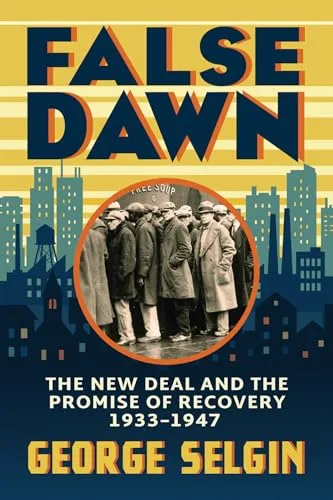
False Dawn
The New Deal and the Promise of Recovery, 1933–1947
- Published
- 2025
- Pages
- 384 pages
- Publisher
- University of Chicago Press
- Readers
- 0 members have read this
Monetary economist George Selgin asks whether the New Deal actually ended the Depression. His answer: gold devaluation and bank stabilization worked, while cartels, wage shocks and hostility to business stalled recovery for years. It is a sharp, data-heavy history for anyone who thinks about policy regimes, expectations and how economies recover from crises.
Popular memory credits Franklin Roosevelt's New Deal with pulling America out of the Great Depression. George Selgin argues the record is far more mixed. The early measures, including stabilizing the banks and raising the gold price from $20.67 to $35, sparked a real revival. The policies that followed, especially the cartel schemes of the National Industrial Recovery Act and the Agricultural Adjustment Act, held it back. Six years in, more than 17% of American workers were still jobless or on work relief, a higher share than at the peak of Covid unemployment.
Selgin is a professor emeritus at the University of Georgia and was the founding director of the Cato Institute's Center for Monetary and Financial Alternatives. He is known for work on free banking and Fed operations, including The Theory of Free Banking, Good Money and The Menace of Fiscal QE. His bent is classical-liberal, but Scott Sumner noted that this is no polemic: Selgin credits Roosevelt with ending the slide in prices and output.
The book collects decades of revisionist research into one readable account. Charles Calomiris called it one of the best books on the Depression, and the Wall Street Journal named it among the best books of 2025. Its most original thread follows how wartime cooperation between business and Washington ended the investor fear that Selgin blames for weak private investment.
Historian Eric Rauchway, a target of the book, pushed back hard in the Business History Review. He argued that Selgin judges the New Deal only on recovery and leaves out relief programs such as the CCC and TVA. He also said Selgin prefers later memoirs to contemporary records. Read it for monetary history, policy uncertainty and the 1937 relapse, alongside a more sympathetic history.
- Monetary regime changes move markets fast. Leaving gold and devaluing the dollar shifted expectations and broke deflation within months, before most New Deal programs were running.
- Raising prices by cutting supply is not stimulus. The NIRA and AAA raised prices and wages by restricting output, which choked off the recovery rather than adding to it.
- The 1937 relapse had several causes. A wage shock, a punitive tax on retained earnings, Fed reserve-requirement hikes, Treasury gold sterilization and hostile rhetoric together produced a sharp relapse in 1937–38.
- Policy uncertainty restrains capital spending. Selgin takes the regime-uncertainty argument seriously: businesses that fear the rules will change keep their cash rather than invest it.
- Measure recovery against potential. Judged by how close output and employment came to full capacity, the 1930s recovery was slow and incomplete, a test worth applying to recoveries since.
The book follows the recovery chronologically, from the banking crisis of early 1933 through the postwar boom.
- The banking crisis and the gold exit. Selgin finds the big New York banks were basically sound and puts more blame on the Federal Reserve banks and the long interregnum between Hoover and Roosevelt. He credits the departure from gold and devaluation to $35 an ounce with reversing deflation, but says it should have come sooner.
- The demand revival. Gold flowing in from a Europe fearful of Hitler, not deficit spending, did much of the monetary work. Roosevelt resisted both deficits and deposit insurance, which Congress forced on him.
- The cartel years. The AAA restricted farm output and the NIRA cartelized industry. After the President's Reemployment Agreement of July 1933, wages jumped about 20% in two months and industrial output stalled for roughly two years.
- Revival and relapse. Recovery resumed once the Supreme Court struck down the NIRA in May 1935. It broke again in 1937–38 under a new wage shock, the undistributed profits tax, attacks on economic royalists, gold sterilization and higher reserve requirements.
- War and rapprochement. Selgin argues that a lasting truce between government and business, more than war spending, ended the fear that had suppressed private investment and set up the postwar boom.
Reader reviews
No reviews yet. Join to write the first one.