
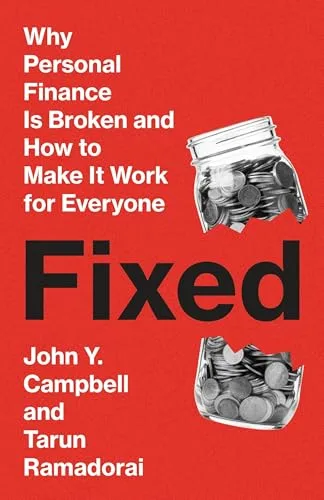
Fixed
Why Personal Finance Is Broken and How to Make It Work for Everyone
by John Y. Campbell and Tarun Ramadorai
- Published
- 2025
- Pages
- 352 pages
- Publisher
- Princeton University Press
- Readers
- 0 members have read this
Two leading household-finance economists, Harvard's John Campbell and Imperial College's Tarun Ramadorai, show how consumer finance is rigged against ordinary customers, from overdraft fees to unrefinanced mortgages, and propose a regulated starter kit of simple, cheap products. Useful for anyone who designs, sells, regulates or invests in retail financial products.
The title has two meanings: personal finance is fixed in the sense of rigged, and it can be fixed like a broken machine. Campbell and Ramadorai argue that money decisions are hard, that their results arrive late and noisily so people rarely learn from them, and that most customers stick with familiar firms instead of shopping around. Providers respond by competing on branding and hidden fees. The mistakes of less sophisticated customers end up paying for perks enjoyed by savvier ones, such as free checking, card rewards and cheap mortgages, which widens inequality. Opting out, through cash at home, loan sharks or crypto, is usually worse.
Campbell is the Morton L. and Carole S. Olshan Professor of Economics at Harvard, a past president of the American Finance Association, author of Financial Decisions and Markets and co-founder of Arrowstreet Capital. Ramadorai is professor of financial economics at Imperial College London and chaired the Reserve Bank of India's committee on household finance in 2016-17.
Unlike self-help guides, the book says financial education mostly helps people who are already well off. Its answer is to shove rather than nudge: in each market, regulators would set the design and fee structure of a simple starter-kit product that every provider must offer. Martin Wolf praised it in the FT, which named it a best book of the year, and The Economist singled out its proposals for products that should exist but do not. The caveat is political. The authors concede that consumer regulation is losing ground in the US and UK, and the plan depends on regulators designing products well.
It belongs on the desk of product heads at banks, fintechs and asset managers, regulators and financial advisers.
- Free products are not free. Free checking, card rewards and low mortgage rates for savvy customers are funded by overdraft fees and by borrowers who never refinance. Retail finance profits often depend on these cross-subsidies.
- Complexity is a business model. When products are hard to compare, firms compete on brand rather than price. Standardized products, like generic painkillers, let competition push fees down.
- Mortgages leak money quietly. Failing to shop and failing to refinance cost borrowers real money, and Danish evidence shows that even an automatic right to refinance is not used by everyone. The authors would ban confusing mortgage points.
- Insure the big risks and skip the small ones. Markups make small-ticket insurance poor value, while longevity is underinsured. Deferred annuities that begin paying late in life are a cheaper way to cover it.
- Shove, don't just nudge. Nudges fade over time. The authors want regulators to set the design of default products and require providers to offer them, a direction that would reshape retail banking, retirement and insurance markets.
The book moves from diagnosis to a product-by-product tour and then to reform.
- Why it is so hard. The opening chapters explain why personal finance is difficult and how the industry exploits that difficulty, through hidden costs, branding wars and cross-subsidies from naive to sophisticated customers.
- What goes wrong day to day. Emergency savings, transaction accounts, overdrafts and expensive short-notice credit, and why so many households cannot cover a few months of spending.
- Making large investments. Housing and education loans: why most borrowers do not shop for a mortgage, why many fail to refinance, the confusion created by mortgage points and the lessons from Denmark's refinancing system.
- Living with risk and securing retirement. Insurance (cover catastrophes, skip small risks), investing (participate, diversify, cut fees, avoid chasing performance) and retirement saving, including deferred annuities and reverse mortgages.
- Technology. Fintech as a turbocharger that cuts costs and helps comparison shopping, but also gamifies trading, pushes buy-now-pay-later credit and enables price discrimination.
- Shove, and a better system. The starter-kit proposal, required choices for the most important products and a single tax-advantaged retirement account that follows workers from their first job.
Reader reviews
No reviews yet. Join to write the first one.