
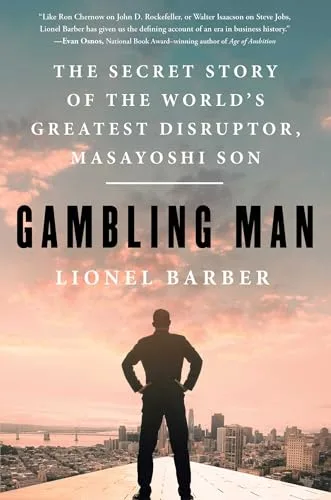
Gambling Man
The Secret Story of the World's Greatest Disruptor, Masayoshi Son
- Published
- 2024
- Pages
- 368 pages
- Publisher
- Atria/One Signal Publishers
- Readers
- 0 members have read this
The former Financial Times editor writes the first Western biography of SoftBank's Masayoshi Son, the risk-loving dealmaker behind early bets on Yahoo and Alibaba, the iPhone in Japan, and both Uber and WeWork. It is a study of how one founder's appetite for leverage and conviction made and lost several fortunes across three tech cycles.
Masayoshi Son grew up poor in an ethnic Korean family in postwar Japan, the son of a pachinko parlor operator, and faced discrimination for his background. He studied at Berkeley, went home to found SoftBank as a software distributor, and turned it into a technology investor that, by Barber's account, has controlled or invested around $1 trillion over two decades. Along the way he made early investments in Yahoo and Alibaba, won the exclusive right to sell the iPhone in Japan with Steve Jobs, and later backed Uber, DoorDash and Slack, as well as WeWork and the dog-walking app Wag.
Lionel Barber edited the FT from 2005 to 2020, and his earlier book, The Powerful and the Damned, was a diary of those years. Here he had the cooperation of many key participants, including Son, and the publisher bills it as the first Western biography of him. Publishers Weekly praised it as a balanced portrait of an ambitious, stubborn and resourceful operator, and Booklist gave it a starred review.
The obvious tension is that the same appetite for risk that produced the Alibaba windfall also produced heavy losses, with WeWork's 2023 bankruptcy the clearest example, and Barber treats both sides. Some readers found it thin on Son's inner life and dense with deal detail, and access to the subject raises the usual question of how hard a biographer can push.
It is useful for venture and growth investors, tech bankers and anyone trying to understand SoftBank's outsized role in the last two tech booms.
- A few winners carry the record. Son's early bets on Yahoo and Alibaba produced his biggest windfalls, which shows how a handful of outsized winners can define an investor's career.
- Risk appetite cuts both ways. The boldness that produced the Yahoo and Alibaba windfalls also produced the dot-com losses and the WeWork debacle, and Barber treats them as one trait.
- Distribution rights can be strategic assets. The exclusive iPhone deal in Japan anchored SoftBank's move into mobile, a reminder that commercial rights can matter as much as equity stakes.
- One dealmaker's enthusiasm is a concentration risk. WeWork and Wag show the cost when a single person's conviction drives large bets.
- Big investors shape ordinary livelihoods. Barber places Son alongside BlackRock, Vanguard and Berkshire Hathaway as investors whose judgments now reach far beyond their own shareholders.
Barber tells the story chronologically in parts that track Son's reinventions.
- Roots. Son's family history, his childhood around the pachinko business, his awakening in America as a student, and the founding of the first SoftBank, including a $450,000 loan he secured with no collateral or track record.
- Rise and fall. SoftBank's dot-com climb, including the Yahoo stake and dealings with Rupert Murdoch, and Son's turn as a paper billionaire before the crash wipes out much of his wealth.
- The operator. Son rebuilds through broadband in Japan, the early Alibaba investment, and a move into mobile, with Steve Jobs and the iPhone central to the deal.
- The global dealmaker. The later chapters follow his courtship of Saudi royals, Donald Trump and Chinese leaders, and the wave of start-up investments, from Uber, DoorDash and Slack to WeWork and Wag.
- What comes next. Barber closes by assessing Son's record, his appetite for new bets after his losses, and his ambitions in the era of AI.
Reader reviews
No reviews yet. Join to write the first one.