
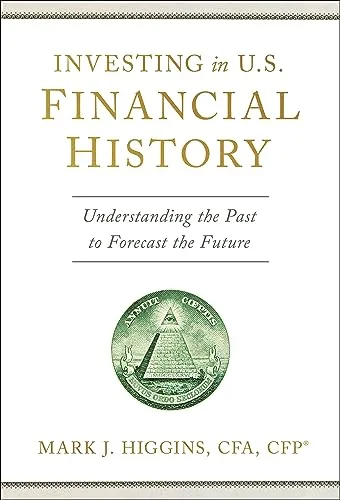
Investing in U.S. Financial History
Understanding the Past to Forecast the Future
- Published
- 2024
- Pages
- 600 pages
- Publisher
- Greenleaf Book Group Press
- Readers
- 0 members have read this
A 600-page, single-volume financial history of the United States, from Alexander Hamilton's 1790 programs to the Federal Reserve's 2023 fight against inflation, written by an institutional investment consultant for investors. Higgins argues that almost no market event is unprecedented, and that knowing the record makes manias, crises and policy errors easier to spot.
Higgins starts from a simple premise: most investors rely on their own experience, which is far too short a sample to show the cycles that keep reshaping markets. His remedy is a chronological survey of American finance that runs from the First Bank of the United States, through the post-Civil War national banking system, late-19th-century industrialization and the credit-fueled stock buying that preceded the Great Depression, to the postwar rise of mutual funds, the growth of Silicon Valley and the inflation of recent years.
Higgins, a CFA charterholder and CFP, spent twelve years as a senior investment consultant to institutional investors with more than $60 billion in assets. He writes for the Museum of American Finance's Financial History magazine and the CFA Institute's Enterprising Investor. He began the project after the March 2020 market shock caught him off guard, and he spent more than three years on the research. The museum later licensed the book for its timeline exhibit in Boston.
Russell Napier noted that few U.S. economic histories tie the story so closely to securities markets, and William Bernstein put it alongside Galbraith's The Great Crash 1929. Publishers Weekly praised Higgins's skill at turning macro trends into a clear narrative but found the sections on fractional-reserve banking and fund structures dense. The book's length is a real commitment, and its conclusion that index funds suit nearly all investors is a stance some active managers will reject.
It suits analysts, advisers and CFA candidates who want historical context they can apply to current markets.
- Your experience is a small sample. Many market principles only show up over spans longer than a career. Studying two centuries of history widens the base rate you judge events against.
- Manias rhyme. Rapid credit expansion and speculative buying, as in the 1920s, leave recognizable warning signs that recur across eras and asset classes.
- Crises follow repeatable mechanics. Bank runs, credit contractions and panics have common drivers, and the responses that worked, or failed, form a playbook worth knowing before the next one.
- Central bank mistakes recur. From the First Bank to the modern Fed, U.S. monetary policy has repeated similar errors, so assuming the Fed will get it right is not a strategy.
- History supports indexing. Few investors beat market indices over time. Higgins concludes that index funds work best for nearly all individuals and institutions.
The book moves chronologically through more than two centuries of American finance, drawing lessons for investors along the way.
- Founding finance. Hamilton's 1790 programs and the First Bank of the United States set up the federal credit and banking framework, and the early fights over central banking begin.
- War and industrialization. Civil War finance gives way to a national banking system that displaces state-chartered banks, followed by the industrial expansion of the late 19th century and its recurring panics.
- Boom and Depression. The credit-based stock speculation of the 1920s leads into the crash and the Great Depression, which Higgins uses to examine how crises start and how they are managed.
- The postwar investment industry. After World War II, mutual funds and a broader investing public grow, and later Silicon Valley reshapes markets and creates new speculative cycles.
- To the present. The narrative runs through the crises of recent decades and the 2020 pandemic shock to the Fed's battle with inflation in 2023. It closes with the case for index funds and the challenges facing the U.S. economy in this century.
Reader reviews
No reviews yet. Join to write the first one.