
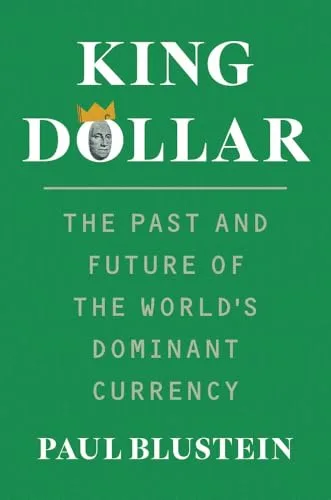
King Dollar
The Past and Future of the World's Dominant Currency
- Published
- 2025
- Pages
- 320 pages
- Publisher
- Yale University Press
- Readers
- 0 members have read this
A veteran Washington Post and Wall Street Journal economics reporter takes on the perennial forecast that the dollar is about to lose its crown. Blustein weighs the renminbi, crypto and the debt hawks against the dollar's track record and concludes that only a self-inflicted policy blunder in Washington could dethrone it. Useful for anyone who prices FX, rates or geopolitical risk.
Every few years a new wave of commentary predicts the end of dollar dominance. Paul Blustein's book is a calm, reported rebuttal. He sorts the doomsayers into three camps: crypto enthusiasts who expect blockchain money to replace the greenback, foreign-policy hawks who see China's renminbi as the threat, and sound-money critics who think US debt and inflation will hollow the dollar out. His verdict is that the dollar's place at the top of the currency pyramid is secure unless the US government makes catastrophic mistakes.
Blustein spent much of his career covering global economics for the Washington Post and the Wall Street Journal, won a Gerald Loeb Award, and has written six earlier books on international finance, among them The Chastening and Off Balance. That background shows in a narrative built around institutions and episodes rather than models.
The book's distinctive move is to treat the dollar as a live policy instrument. Blustein covers how Washington has turned dollar access into a sanctions weapon against adversaries such as Russia, how targets have learned to blunt the damage, and why he thinks the weapon keeps its force. He also explains the Federal Reserve's role as the world's lender of last resort in 2008 and 2020.
The caveat reviewers flagged is timing: Ian Harwood of the Society of Professional Economists noted that the book's optimism faces a test under Donald Trump's second term, which Blustein concedes could take the dollar into uncharted waters. A paperback with a new preface followed in April 2026. Read it alongside Kenneth Rogoff's Our Dollar, Your Problem for a second view.
- Decline calls have a poor record. Predictions that the twin deficits would sink the dollar have failed again and again, from the 1970s slide onward; treat the next one with the same skepticism.
- Deficits alone don't topple a currency. An external deficit above 5 percent of GDP before 2008 brought no disorderly fall, and in early 2025 the real trade-weighted dollar sat near its level before August 1971.
- Sanctions are powerful but leak. Dollar-based sanctions can inflict severe damage, yet targets such as Russia have found ways to soften them, which matters for anyone modeling sanctions risk.
- The Fed is part of the moat. Its emergency role as global lender of last resort in 2008 and 2020 reinforced foreign reliance on dollars.
- The main threat is domestic. Blustein's warning is that only a serious US policy error could undo dollar dominance, so watch Washington more closely than Beijing or the blockchain.
The book moves from history to the live debate, then to the dollar as a weapon and the newer digital challengers.
- How the dollar got to the top. Blustein traces the dollar's rise past sterling roughly a century ago and its role anchoring the postwar system, then the August 1971 end of gold convertibility under Nixon.
- Survival through crisis. The 1970s slide, the 1978 issue of US bonds in foreign currencies to shore up confidence, Paul Volcker's war on inflation and the 1985 Plaza Accord show how often the dollar's demise was announced too early.
- The deficit scare. Blustein tests the twin-deficits argument, noting that an external deficit above 5 percent of GDP before the global financial crisis did not set off a disorderly fall.
- Pretenders to the throne. A chapter of that name weighs the rival candidates, with China's renminbi as the most discussed.
- The dollar as a weapon. Trade and financial sanctions, the Russian case and the workarounds targets have built.
- Crypto, digital money and the Fed. The challenge from Bitcoin and digital currencies, and the Fed's role as global lender of last resort in the 2008 crisis and the pandemic, which Blustein presents as a pillar of dollar primacy.
Reader reviews
No reviews yet. Join to write the first one.