
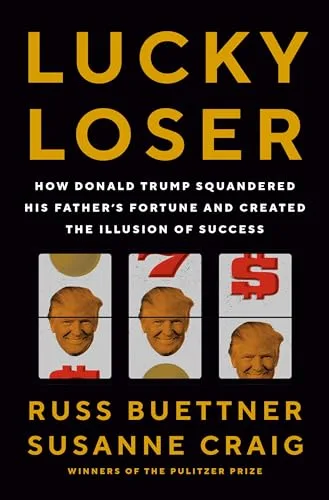
Lucky Loser
How Donald Trump Squandered His Father's Fortune and Created the Illusion of Success
by Russ Buettner and Susanne Craig
- Published
- 2024
- Pages
- 528 pages
- Publisher
- Penguin Press
- Readers
- 0 members have read this
Two Pulitzer-winning New York Times reporters use more than twenty years of Donald Trump's confidential tax data, business records and interviews to rebuild his financial history, from his father's real estate fortune through Atlantic City and The Apprentice. It is a detailed case study in leverage, family money, licensing income and the gap between reported and actual results.
Russ Buettner and Susanne Craig have reported on Donald Trump's finances for the New York Times since 2016. Their 2018 investigation of the Trump family's wealth and tax strategies, written with David Barstow, won the 2019 Pulitzer Prize for Explanatory Reporting. Craig previously covered Wall Street for the Times and worked at the Wall Street Journal. The book extends that reporting into a full financial biography spanning nearly a century.
The authors' thesis is in the subtitle. Trump has long described building his business from a small loan from his father. Drawing on tax records, legal settlements and financial documents, they argue that he instead received family support worth more than $500 million in today's dollars, that his businesses lost more than $1 billion between 1985 and 1994, and that a second windfall from The Apprentice and the licensing deals that followed revived his finances. They also argue he would have done better putting his money in the stock market.
For a finance reader, the value is in the mechanics: properties bought at high prices, overspending on construction and decor, debt loaded onto assets, a $15 million loan from his father that was later written off, and the role of a carefully maintained public image. Kirkus and Publishers Weekly both noted that longtime Trump watchers will know the broad outline, while praising the depth of documentation. The Trump campaign called the book lies and an attempt to interfere in the 2024 election, and in 2025 Trump filed a $15 billion defamation suit against Penguin Random House and the Times over the book and related reporting.
Read it as forensic financial reporting on a highly leveraged family real estate business.
- Separate inherited capital from returns. The book shows how a large family stake, credit and guarantees can make a career look self-made when the underlying returns are weak.
- Leverage magnifies a bad entry price. The authors document properties bought at high prices and loaded with debt, which sometimes forced sales at a loss.
- Brand licensing can outearn operating assets. Income from The Apprentice and from licensing the Trump name rebuilt his finances after the real estate and casino losses.
- Tax returns tell a different story than press releases. Confidential tax records let the reporters compare actual losses and income with public claims about net worth.
- Benchmark against the index. The authors argue that a passive stock market investment of the same money would have beaten his results, a useful test for any concentrated private portfolio.
The book moves chronologically through two generations, using tax and business records to test each stage of the public story.
- The father. The opening chapters follow Fred Trump's New York real estate business and the cautious habits, estimating revenue carefully and spending only what he expected to earn, that made the family rich.
- The son takes over. Donald joins the business around 1968 and makes grand announcements about projects, many never built, while the authors trace how his father's money, credit and connections backed his early deals.
- Expansion and losses. Hotels, casinos in Atlantic City, an airline and other ventures pile up debt. The authors document more than $1 billion in business losses from 1985 to 1994 and the family support, including a $15 million loan his father wrote off, that kept him afloat.
- The Apprentice. Producer Mark Burnett's show recasts Trump as a model executive, and the television income plus licensing of the Trump name produce a second fortune.
- The later ledger. The closing chapters and epilogue assess what he spent, what he still holds, and the tax positions and pending legal judgments that put it at risk.
Reader reviews
No reviews yet. Join to write the first one.