
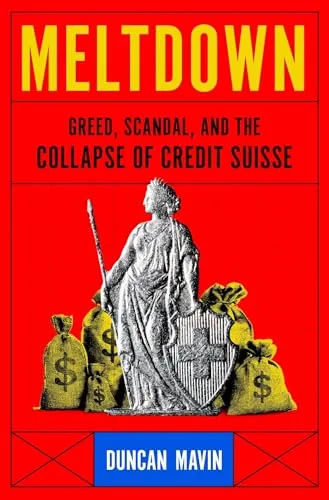
Meltdown
Greed, Scandal, and the Collapse of Credit Suisse
by Duncan Mavin
- Published
- 2024
- Pages
- 336 pages
- Publisher
- Pegasus Books
- Readers
- 0 members have read this
A 166-year-old Swiss bank ran out of trust before it ran out of capital, and former Wall Street Journal financial editor Duncan Mavin shows how. From Nazi gold and secret accounts to Archegos and the 2023 forced sale to UBS, it is a concise record of how weak risk controls, empire-building and a long run of scandals can destroy a global bank.
Credit Suisse did not die from a single bad bet. Mavin's account shows a bank undone by decades of misconduct and mismanagement: helping Nazi Germany turn looted assets into deposits, secret banking for regimes such as Libya and Iran, helping wealthy Americans dodge taxes, selling poor mortgage-backed securities before 2008, spying on its own executives, and banking dictators and drug dealers. Kirkus quotes the book's count of more than $15 billion in fines for employee misconduct after 2010. In March 2023 Swiss authorities declared the bank unviable and pushed it into UBS.
Mavin traces the rot to the 1988 deal for First Boston, which grafted American investment-banking risk-taking onto a conservative Swiss lender without the systems to control it. Power struggles kept the top unstable, with four CEOs in one seven-year stretch. His core argument is that the bank usually had enough capital but ran out of trust, and that bad investments, especially the $5.5 billion Archegos loss, mattered more than any one scandal.
Mavin spent a decade as a chartered accountant before reporting for Dow Jones, where he wrote the Wall Street Journal's Heard on the Street column and was its financial editor for Europe, the Middle East and Africa. His earlier book, Pyramid of Lies, covered Lex Greensill, one of Credit Suisse's most notorious clients.
Readers who followed the collapse in the financial press will recognize many episodes; the value is in having them in one causal chain. The New York Times review found less a grand tragedy than a long procession of grifts and mistakes. Essential for risk managers, bank analysts and anyone weighing a too-big-to-fail balance sheet.
- Trust is the binding constraint. Mavin's main lesson is that Credit Suisse usually had enough capital but lost the confidence of clients and counterparties, and a bank cannot survive that.
- Culture clashes in M&A are risk events. The First Boston deal imported a high-risk business without the controls to manage it, a problem that lasted decades.
- Fines are a leading indicator. More than $15 billion in misconduct fines after 2010 signaled governance failures long before the final run.
- Prime brokerage concentration kills. The Archegos loss showed how a single client's leverage can blow a hole in a weakened bank.
- Leadership churn compounds weakness. Four CEOs in seven years and constant internal feuding left the bank without a steady hand when crises hit.
The book moves chronologically from the bank's origins to its forced sale, with excursions from Zurich to Mozambique, Australia, Hong Kong and New York.
- The Swiss bastion. Founded in the 1850s, the bank builds a reputation for discretion, while its wartime dealings help Nazi Germany convert looted gold and art.
- The First Boston gamble. The 1988 deal pulls Credit Suisse into US investment banking, bringing early profits, a risk culture at odds with Zurich, and boardroom feuds such as the abrupt firing of co-CEO John Mack.
- Decades of scandal. Secret accounts for regimes such as Libya and Iran, US tax evasion cases, mortgage-backed securities before 2008, money laundering for autocrats and executives spying on each other, with fines topping $15 billion after 2010.
- The bad bets. Losses from bad investments mount, four CEOs come and go in seven years, and the Archegos debacle, which cost the bank $5.5 billion, exposes weak risk controls.
- Collapse. In March 2023, with confidence gone, Swiss regulators declare the bank unviable and arrange its takeover by UBS.
Reader reviews
No reviews yet. Join to write the first one.