
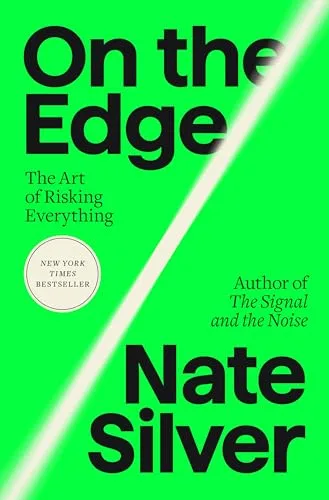
On the Edge
The Art of Risking Everything
by Nate Silver
- Published
- 2024
- Pages
- 576 pages
- Publisher
- Penguin Press
- Readers
- 0 members have read this
The FiveThirtyEight founder and high-stakes poker player maps the River, the tribe of poker pros, sports bettors, hedge fund traders, venture capitalists and crypto founders who think in expected value. For finance readers it is a field guide to how edge, variance and risk of ruin are actually priced, and to what happened when Sam Bankman-Fried ignored them.
Nate Silver's argument is that American life has split between two cultures. The Village is the cautious, consensus-minded establishment of media, academia and government. The River is a loose community of people who compute odds, look for an edge and bet against the crowd when the numbers support it: poker players, sports bettors, quants, hedge fund managers, venture capitalists and crypto entrepreneurs. Silver argues that the River now controls a growing share of money and power, and that its habits of mind explain much of how modern markets behave.
Silver writes as an insider. He built FiveThirtyEight on probabilistic forecasting, left it in 2023, plays poker for high stakes and advises the prediction market Polymarket. He interviewed some 200 people, including Sam Bankman-Fried before, during and after the FTX collapse, and Silicon Valley investors who rarely talk to journalists. The book is longer and more personal than The Signal and the Noise and reads partly as memoir.
The finance material is the reason to read it here. Silver explains why sportsbooks limit winning bettors, how venture capital returns depend on a few outsized wins and on deal flow, and why Bankman-Fried's appetite for risk of ruin was a fatal misreading of expected value. Reviewers were divided. Kirkus called it a clever look at a unique world but said the River-versus-Village model breaks down when pushed. Foreign Policy and National Review found it sprawling and too easy on the gambling industry, and a finance-minded Substack reviewer flagged loose claims about hedge fund goals and VC benchmarks.
Read it if you trade, allocate to venture or want a sharper vocabulary for edge, variance and bankroll management.
- Edge comes first. Every River trade starts with a clear answer to why you, and not the counterparty, have the better side. If you can't name the edge, you are probably the customer.
- Winners get limited. Sportsbooks cap or ban bettors who beat them consistently, a reminder that any market will move against a participant who keeps taking its money.
- Venture is a power-law business. Most investments return little or nothing, so top firms win through deal flow and a few outsized hits rather than a high hit rate.
- Risk of ruin is not negotiable. Bankman-Fried argued that bigger players can afford to take on more risk. Silver shows how that logic, applied to a balance sheet, ended at FTX.
- Think in probabilities, not narratives. Silver's habits of successful risk-takers, such as staying process-oriented, updating like a Bayesian and preparing obsessively, carry over directly to position sizing and investment committees.
The book opens with a prologue and an introduction that set out the River and the Village, then splits into two parts separated by a halftime interlude.
- Part 1: Gambling. Four chapters (Optimization, Perception, Consumption, Competition) move from game-theory-optimal poker and the psychology of the high-stakes table to the business model of Las Vegas casinos and the sports betting market, where profitable bettors such as Billy Walters operate and sportsbooks restrict winners.
- Halftime. An interlude lists thirteen habits of highly successful risk-takers, drawn from Silver's interviews.
- Part 2: Risk, Silicon Valley. Silver turns to venture capital: founders who embrace variance, the power-law return profile of top firms, the herding of a Keynesian beauty contest, and bets on figures such as Adam Neumann.
- Part 2: Crypto and FTX. He covers the crypto boom and spends long stretches with Sam Bankman-Fried, tracing how FTX's founder misjudged risk of ruin and how the firm collapsed.
- Part 2: Effective altruism and AI. The later chapters, ending with Termination, examine the rationalist and effective altruist communities, their ties to Bankman-Fried and their bets on the risks of artificial intelligence.
- Foundation. A closing chapter, numbered 1776, draws the threads together. It is followed by a note on methods and sources and a glossary titled How to Speak Riverian.
Reader reviews
No reviews yet. Join to write the first one.