
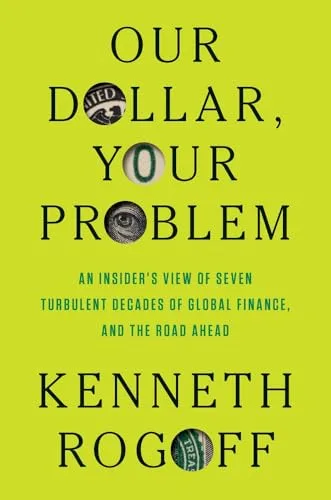
Our Dollar, Your Problem
An Insider's View of Seven Turbulent Decades of Global Finance, and the Road Ahead
- Published
- 2025
- Pages
- 360 pages
- Publisher
- Yale University Press
- Readers
- 0 members have read this
A former IMF chief economist explains how the dollar beat the yen, the ruble and the euro, why its dominance was never guaranteed, and why the biggest threats to it now come from Washington: rising debt, the end of ultra-low rates and pressure on Fed independence. Essential context for anyone who prices Treasuries, currencies or reserve assets.
The title borrows Treasury Secretary John Connally's 1971 line to European finance ministers, that the dollar was America's currency but their problem. Rogoff traces how the dollar pulled ahead of the Japanese yen, the Soviet ruble and the euro after the war, then weighs the current threats: crypto, the Chinese yuan, the end of reliably low inflation and interest rates, political instability and cracks in the dollar bloc. His case is that network effects make a dominant currency close to a natural monopoly, with the exorbitant privilege of cheap borrowing, but that luck played a part, and overconfidence invites unforced errors.
Rogoff is the Maurits C. Boas Professor of Economics at Harvard. He was chief economist of the IMF from 2001 to 2003, after earlier stints as an economist at the Fed Board and the Fund. He also co-wrote This Time Is Different with Carmen Reinhart, and he is a chess grandmaster. The book grew out of his Henry L. Stimson Lectures at Yale, and it mixes memoir with history, so policy episodes in Russia, Japan, China and emerging markets come with his own seat at the table.
Martin Wolf in the Financial Times and Ben Bernanke praised it, The Economist called its argument timely, and James Grant in The Wall Street Journal found that the autobiographical threads strengthen the monetary story. It was a PROSE Award finalist. The caveats are mostly about scope. Lael Brainard, reviewing it in Foreign Affairs, stressed how hard a dominant currency is to dislodge. Rogoff himself expects gradual erosion rather than collapse, so readers looking for a dollar-crash call will not find one.
It suits rates and FX traders, macro strategists, reserve managers and anyone who invests in emerging-market debt.
- Dominance is a network effect. The dollar wins because everyone else uses it, which makes it sticky but not permanent. Rogoff credits part of its rise to luck and rivals' mistakes.
- The privilege has a price. Cheap US borrowing and swap-line power come with spillovers: American financial power can transmit instability abroad and feed it at home.
- The real threat is domestic. Debt heading toward about 160 percent of GDP by 2055 and political pressure on the Fed worry Rogoff more than China or crypto.
- Low rates were an era, not a law. He argues the period of reliably low inflation and interest rates is over and that financial repression cannot hold down funding costs for long. Duration investors should plan for that.
- Expect erosion, not collapse. No challenger, from the yen to bitcoin, has had the full package of depth, openness and trust. The likely path is a slow loss of share, which argues for gradual hedging rather than crash bets.
After an opening chapter on how a currency becomes dominant, the book unfolds in six parts that move from history to forecast.
- Past challengers. Why the yen, the Soviet ruble and the euro each looked like a threat to the dollar and each fell short.
- The present-day challenger. China and the yuan, including exchange-rate rigidity and the limits that capital controls put on a would-be reserve currency.
- Living with the dollar. How other countries cope with dollar-driven inflation, debt and currency crises, including the reserve build-up and selective controls Asian economies adopted after the 1997-98 crisis, which Rogoff labels a Tokyo Consensus.
- Alternative currencies. Crypto and other private or digital rivals, and why they have not displaced government money.
- Perks and burdens. The exorbitant privilege, America's role as banker to the world, Fed swap lines and the link between reserve-currency status and geopolitical power.
- Peak dollar dominance. The risks from within: pressure on central-bank independence, US debt projected toward about 160 percent of GDP by 2055, and the case that rates cannot stay low forever and financial repression is no fix.
Reader reviews
No reviews yet. Join to write the first one.