
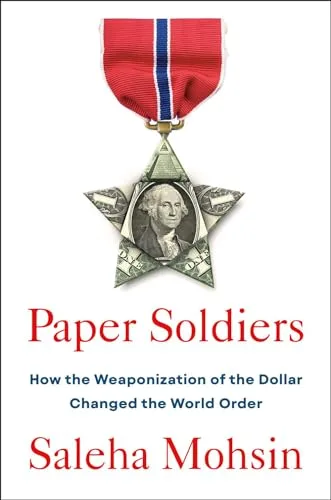
Paper Soldiers
How the Weaponization of the Dollar Changed the World Order
- Published
- 2024
- Pages
- 304 pages
- Publisher
- Portfolio
- Readers
- 0 members have read this
A Bloomberg reporter's history of how the Treasury Department turned the dollar into an instrument of power, from Robert Rubin's 1995 strong-dollar mantra through the post-9/11 financial war to the 2022 sanctions on Russia. It is useful context for anyone pricing currency risk or sanctions exposure, or arguing about how long dollar dominance can last.
Mohsin's subject is the Treasury, not the Fed. She argues that for three decades Treasury has used the dollar's reserve status on two fronts. At home, the strong-dollar policy Robert Rubin turned into a mantra in 1995 drew in foreign capital and cheap imports, but it also helped hollow out manufacturing towns such as Weirton, West Virginia, and Moraine, Ohio. Abroad, financial sanctions became Washington's preferred weapon after 9/11. Her warning is that the biggest threat to the dollar is domestic: political dysfunction, unpredictability and eroding trust in American institutions.
Mohsin is Bloomberg News's senior Washington correspondent and has covered Treasury for years. She draws on hundreds of interviews, including with Rubin, Steven Mnuchin and Janet Yellen, and her scenes come from inside Treasury meeting rooms and negotiations with Beijing.
Economists' histories of the dollar, such as Barry Eichengreen's Exorbitant Privilege, start from the macroeconomics. Mohsin works as a reporter, through personalities, career civil servants and specific decisions. Reviewers praised the reporting and how easy the book is to follow. Lawfare's Alex Zerden, who discloses that he edited one chapter, wished it said more about the New York Fed's foreign-policy role, rival payment systems and central bank digital currencies, and allies' reluctance to enforce U.S. sanctions. Peter Earle, writing in the Quarterly Journal of Austrian Economics, found parts oversimplified and objected to its link between democracy and currency strength.
It suits FX and macro traders, sanctions and compliance teams, emerging-market investors and anyone who reads Treasury statements for market signals.
- Treasury owns the dollar message. Exchange-rate policy is Treasury's call, and markets parse every word. Mnuchin's 2018 Davos comment showed how one line can move the currency.
- A strong dollar sends a domestic bill. Capital inflows and cheap imports came alongside the decline of manufacturing communities, a cost that fed populist anger and trade conflict.
- Sanctions run on dollar plumbing. Treasury's reach, through OFAC designations and access to dollar clearing, comes from the dollar's central role. For banks and corporates, sanctions risk scales with dollar dependence.
- Overuse has collateral damage. The 2018 Rusal case disrupted global aluminum supply and put European jobs at risk, which forced a reckoning inside Treasury that Jack Lew had warned of two years earlier.
- The main threat is homegrown. In Mohsin's telling, debt-ceiling brinkmanship and erratic policy threaten dollar credibility more than rival currencies or payment networks do.
The book opens at Davos in January 2018, when Steven Mnuchin's remark that a weaker dollar was good for the U.S. knocked the currency lower and briefly raised fears of a currency war. It then steps back and moves forward chronologically.
- Foundations. A short primer runs from the Civil War-era Legal Tender Act through the 1944 Bretton Woods system and its 1971 collapse, then to Paul Volcker resisting rate pressure from the Reagan White House and James Baker's 1985 Plaza Accord.
- The strong-dollar era. Rubin's 1995 confirmation-hearing line becomes bipartisan doctrine for about two decades, delivering prosperity and cheap goods while factory towns pay the price.
- The dollar goes to war. After 9/11, Treasury turns dollar access into a weapon against terrorist financiers, including through a program that tapped SWIFT data. Later come restrictions that hammered Iran's currency and Stuart Levey's team's discovery of about $30 billion in Libyan assets in 2011.
- Strain and overuse. Treasury plans for a possible default during the 2011 debt-ceiling fight. Jack Lew warns in 2016 against overusing sanctions. In 2018 the Rusal and Oleg Deripaska sanctions under Mnuchin roil the aluminum market, alongside the trade war with China.
- Russia and after. Yellen's Treasury builds a multinational coalition for the sweeping February 2022 sanctions on Russia, and Mohsin closes by asking whether the dollar's power is now at risk.
Reader reviews
No reviews yet. Join to write the first one.