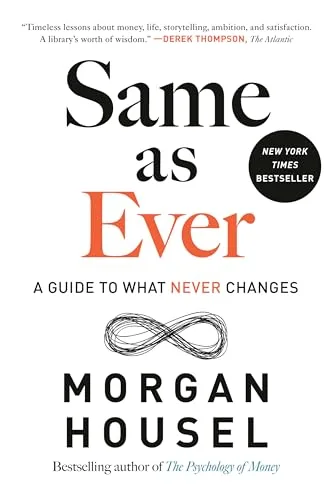
Same as Ever
A Guide to What Never Changes
- Published
- 2023
- Pages
- 240 pages
- Publisher
- Portfolio
- Readers
- 0 members have read this
Morgan Housel's follow-up to The Psychology of Money flips the forecasting habit on its head: instead of guessing what will change, he catalogs the behaviors that never do, such as greed, fear, envy and the pull of a good story. It is a short, story-driven book about risk that helps investors stop betting on predictions and start building for surprises.
Most investment plans, Housel points out, are extrapolations from the past dressed up as forecasts, and forecasts mostly fail. His alternative is to study the things that stay constant across centuries: how people respond to risk, incentives, expectations and stories. Each of the book's 23 short chapters takes one of those constants and illustrates it with history, from the wind that let George Washington's army slip off Long Island to the collapse of Lehman Brothers.
Housel is a partner at the Collaborative Fund and a longtime financial writer who has twice won the SABEW Best in Business award and twice been a Gerald Loeb Award finalist. His first book, The Psychology of Money, sold about 4 million copies, and many of these chapters began as posts on his Collaborative Fund blog.
The book works best as an antidote to false precision. Housel argues that the events that matter most are the ones nobody predicted, so the useful question is not what will happen next but how to stay solvent and patient when something unforeseen does. That makes it a natural companion to Nassim Taleb's work on uncertainty, written in a lighter, essayistic register.
The caveats are real. Kirkus found the structure meandering, with personal anecdotes that drift from the theme and conclusions that sometimes pull against each other, and readers of The Psychology of Money will recognize several ideas. It suits early-career analysts, financial advisers and anyone who has to explain to clients why forecasts disappoint.
- Plan for behavior, not events. Forecasts of specific recessions or crashes rarely work, but greed, fear and overconfidence show up reliably in every cycle. Build strategies around those constants rather than around a point forecast.
- The risk that matters is the one you can't see. The shocks that do the most damage are the ones nobody priced in, so the defense is margin of safety, savings and room for error rather than better prediction.
- Calm sows the seeds of crazy. Long stretches of stability encourage the leverage and complacency that end them. A quiet market is a reason for more caution, not less.
- Bad news is fast, good news is slow. Failures like Lehman Brothers happen overnight while progress compounds over decades, so headlines will always make the world look worse than it is getting.
- Incentives and stories beat data. People believe what they are paid to believe and act on the most persuasive story, not the most accurate spreadsheet. Ask what a forecaster's incentives are before trusting the forecast.
The book opens with an introduction on what never changes, runs through 23 short, self-contained chapters, and closes with a list of questions for readers to ask themselves. The chapters fall into a few loose clusters:
- Chance and hidden risk. Hanging by a Thread and Risk Is What You Don't See argue that history turns on small accidents, and that the biggest risks are the ones nobody is watching.
- Expectations and outliers. Expectations and Reality, Wild Minds and Wild Numbers cover why satisfaction depends on expectations (Charlie Munger appears here), why exceptional people often come with extreme flaws, and why rare events are common in a world of billions.
- Stories and irrationality. Best Story Wins, Does Not Compute and Calm Plants the Seeds of Crazy show how narratives beat data, why models miss human behavior, and how stability breeds the complacency that ends it.
- Progress and effort. Overnight Tragedies and Long-Term Miracles and Tiny and Magnificent contrast sudden bad news, like Lehman's failure, with good news that compounds too slowly to make headlines; It's Supposed to Be Hard and Keep Running argue that every goal has a price and every advantage erodes.
- Incentives and experience. The closing run, including Incentives: The Most Powerful Force in the World, Time Horizons and Wounds Heal, Scars Last, covers how incentives shape beliefs, why long-term thinking is hard to sustain, and how lived experience colors views of risk.
Source title: Same as Ever: A Guide to What Never Changes
Reader reviews
No reviews yet. Join to write the first one.