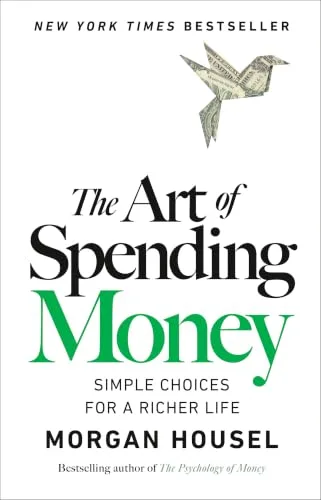
The Art of Spending Money
Simple Choices for a Richer Life
- Published
- 2025
- Pages
- 256 pages
- Publisher
- Portfolio
- Readers
- 0 members have read this
Morgan Housel follows The Psychology of Money with the other half of the problem: how to use wealth once you have it. Through short, story-driven chapters, he argues that status spending has no finish line, that over-saving is its own mistake, and that the best return money buys is independence. It is useful for well-paid professionals, and for advisors who counsel them.
Personal finance writing is mostly about accumulation: earn more, save more, invest well. Morgan Housel looks at the part that gets less attention, which is spending. He offers no budgets or rules. Instead he looks at why people spend the way they do, and how often purchases meant to impress, soothe or signal fail at the job. His central claims are that peace of mind is the best return on money, that expectations matter more than income, and that self-awareness beats spreadsheets.
Housel is a partner at the venture firm Collaborative Fund and a two-time winner of SABEW's Best in Business award. He is also a two-time Gerald Loeb finalist and a New York Times Sidney Award winner. This book is the follow-up to his best seller The Psychology of Money. Chris Davis of Davis Advisors and Jason Zweig of the Wall Street Journal both endorsed it.
What sets it apart is the angle. Most money books treat frugality as the goal. Housel treats both overspending and hoarding as failures. He separates admiration from envy, comfort from excess, and usefulness from status. He also cites research suggesting that above about $100,000 of income, more money does little for people who are already unhappy. Publishers Weekly found the advice prudent and insightful.
Some readers will find it thin. Michael James wrote that people with healthy money habits will see little that surprises them, and that the advice may not reach those who most need it. One commenter on that review called it a very American book about status. It suits professionals early in high-earning careers, and anyone who has saved diligently but never decided what the money is for.
- Independence is the best return. The most valuable thing money buys is control over your own time and choices, which argues for a margin of savings over a bigger lifestyle.
- Status spending never ends. There is always someone with more, so purchases meant to signal success bring brief satisfaction and constant comparison.
- Price the cost of earning more. A promotion or higher-paying role has costs in hours, stress and autonomy that should be counted before taking it.
- Hoarding is a failure mode too. Saving out of fear while skipping what would make life better is as much a money mistake as overspending.
- Make luxuries occasional. A favorite restaurant or trip stays special when it is rare. Turning treats into routine erodes the pleasure while the costs stay the same.
The book is a series of short, self-contained chapters, each built around a story or one idea, rather than a step-by-step program. They group into a few broad themes.
- Why we spend. Spending is personal and emotional, shaped by upbringing, culture and identity, so no universal rule fits. Housel warns that money controls people who do not spend it on purpose.
- Status and envy. Status spending has no ceiling because someone always has more. People confuse admiration with envy, and social media now makes everyone a neighbor to compare yourself with.
- What money buys well. Independence, time, relationships and experiences outlast possessions. Favorite luxuries stay special when they are occasional treats rather than routine.
- The cost of more. Before chasing a higher income, weigh what earning it will take. Expectations, not income, set how satisfied you feel.
- Saving as freedom, not hoarding. Saving buys independence from others' control, but excessive saving out of fear is a mistake too. Big decisions need both feelings and numbers.
Reader reviews
No reviews yet. Join to write the first one.