
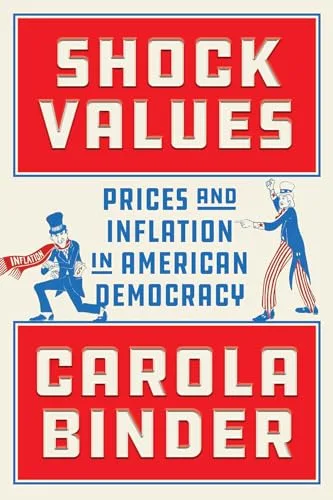
Shock Values
Prices and Inflation in American Democracy
- Published
- 2024
- Pages
- 352 pages
- Publisher
- University of Chicago Press
- Readers
- 0 members have read this
A monetary economist traces how American fights over prices, from colonial paper money to the pandemic inflation, created many of the institutions that rates and macro investors watch today, including the Federal Reserve and the Treasury-Fed Accord. It is a compact history of why inflation is always a political question as well as a monetary one.
Carola Binder studies inflation expectations and monetary policy. She taught at Haverford College from 2015 to 2024 and is now an associate professor at the University of Texas at Austin, an NBER research associate and a nonresident fellow at Brookings. That background shows in her attention to perceived as well as real price instability, and to how both drive political choices.
Her argument is that many of the turning points in U.S. economic history came during price shocks, either surges or collapses, and that the government's responses lasted long after the shock. Hesitation over paper money, wartime price controls, the creation and growth of the Federal Reserve, and inflation targeting were all, in her telling, institutional reactions to the most recent failure. Each episode reshaped the American state and the farm and industry interests that fought over monetary policy.
The Wall Street Journal named it one of its ten best books of 2024 and noted that it weighs Milton Friedman's monetary view of inflation alongside political causes. Its review quotes also highlight coverage of non-monetary tools such as price ceilings and floors, tariffs, antitrust, rent controls and the minimum wage. Tyler Cowen, Diane Coyle and Scott Sumner have all praised it. It runs from the colonial era to the 2020s in under 300 pages of text, so each episode gets a chapter, not a full monograph.
It is a strong choice for rates traders, Fed watchers and anyone who wants historical context for the post-pandemic inflation and the politics around central bank independence.
- Price shocks build institutions. Binder shows that the Fed, price-control agencies and inflation targeting each grew out of a specific bout of price instability, so today's framework is a stack of past reactions.
- Inflation is political, not only monetary. Farm, industry and other interest groups fought over money for two centuries, and those fights shaped policy as much as economic theory did.
- Governments reach for non-monetary tools. Price controls, tariffs, antitrust and rent controls recur whenever inflation becomes politically painful, which is worth remembering in any inflation cycle.
- Independence was negotiated. Binder gives a full chapter to the Korean War era and the Treasury-Fed Accord, a reminder that the Fed's room to act apart from Treasury is a political settlement that can be reopened.
- Perceived instability counts. Binder treats perceived as well as real price swings as drivers of policy, so public perception of inflation can reshape institutions as much as the data do.
Fourteen chapters move chronologically from the colonies to the present, each built around a price shock and the institutions it produced.
- Colonies to the Civil War. Colonial paper money, financing the Revolution and the new nation, and the Jacksonian and Civil War fights over banking and currency.
- The money question. The postbellum battles over gold, silver and deflation, then the Federal Reserve Act and the inflation of World War I.
- Depression and war. Deflation and stabilization in the 1920s, the Great Depression and New Deal, and World War II price controls under the Office of Price Administration.
- The modern Fed takes shape. The Korean War and the Treasury-Fed Accord, the Great Inflation, and the Volcker disinflation and Greenspan years.
- Targets, crises and the return of inflation. Inflation targeting and the Great Recession, the pandemic price surge, and a closing chapter on what the history suggests for future policy.
Reader reviews
No reviews yet. Join to write the first one.