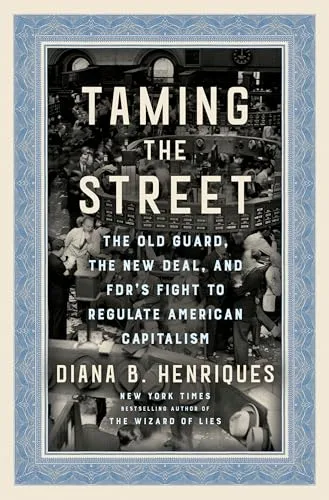
Taming the Street
The Old Guard, the New Deal, and FDR's Fight to Regulate American Capitalism
- Published
- 2023
- Pages
- 464 pages
- Publisher
- Random House
- Readers
- 0 members have read this
Diana Henriques tells how Franklin Roosevelt's New Deal brought Wall Street under federal oversight, pitting Joseph Kennedy and William O. Douglas against New York Stock Exchange president Richard Whitney. For anyone in markets, it explains where the SEC and today's investor protections came from, and how hard they were to win.
Before the New Deal, Wall Street largely policed itself, and Henriques shows what that meant: insider trading and self-dealing, banks selling bonds they knew were worthless, and investors staging artificial rallies to unload stock on the public. After the 1929 crash and the Depression, Roosevelt campaigned in 1932 on making markets safer for ordinary savers. The book follows the fight that produced the Securities and Exchange Commission and its oversight of over-the-counter stocks, utility holding companies and the New York Stock Exchange.
Henriques was a New York Times staff writer from 1989 to 2012, won a George Polk Award, and wrote The Wizard of Lies, about Bernie Madoff, and A First-Class Catastrophe. She builds this story around four men: Roosevelt; Joseph P. Kennedy, the first SEC chairman; William O. Douglas, the Yale law professor who succeeded him; and Richard Whitney, the NYSE president who fought federal oversight until he was caught embezzling client assets in 1938. Publishers Weekly praised its vivid portraits and its ability to make SEC regulation lively, but found its picture of Roosevelt too admiring. Kirkus called it a readable history that gives defenders of regulatory oversight plenty of support, so free-market readers should expect a clear point of view. Henriques also notes that some practices the SEC once curbed, such as short selling, are back in full force.
Read it for the origin story of the rules most finance professionals work under every day, and for the reminder that those rules were contested at every step.
- Investor protection was a political fight. Federal securities rules came out of a battle with an industry that opposed nearly every new requirement, not out of consensus.
- Self-regulation has limits. The NYSE insisted it could govern itself until Richard Whitney, its leading defender against federal oversight, was caught embezzling client assets in 1938.
- Who runs the regulator matters. Roosevelt's choices, first Joseph P. Kennedy and then William O. Douglas, shaped how quickly and how hard the new SEC pushed.
- Honest downturns differ from fraudulent ones. Markets still fell after the SEC arrived, but those slumps tracked the business cycle rather than the Ponzi-like collapse of the early Depression.
- Old fights come back. Practices the New Deal reined in, such as short selling, have returned, and the arguments over how much to regulate Wall Street still echo the 1930s.
The book runs in eleven chapters, from A Quartet for a Calamity to The Fight for the Future, and follows the story roughly in order.
- The unregulated market. The 1920s boom and 1929 crash, with the manipulation and self-dealing that ruined small investors, and Roosevelt's tentative steps toward financial regulation as governor of New York, when he passed over Robert Moses for a regulatory role.
- The 1932 mandate. Roosevelt wins the presidency promising to protect savers and investors, and his administration takes on the financial old guard.
- Building the SEC. Congress creates the Securities and Exchange Commission, and Joseph P. Kennedy becomes its first chairman.
- Extending the reach. Under William O. Douglas, the agency moves on utility holding companies, over-the-counter markets and the New York Stock Exchange itself, which resists at every turn.
- Whitney's fall. The 1938 exposure of Richard Whitney's embezzlement undercuts the exchange's case for self-regulation.
- The legacy. Henriques closes on how the New Deal settlement shaped the way other people's money is managed today, and asks what capitalism owes the common good.
Reader reviews
No reviews yet. Join to write the first one.