
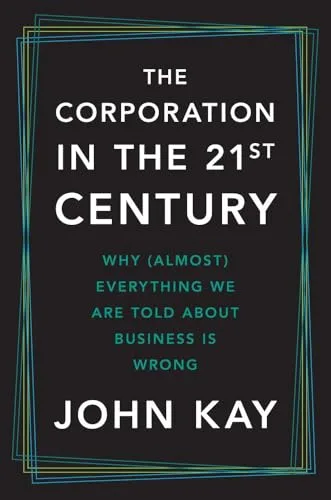
The Corporation in the Twenty-First Century
Why (Almost) Everything We Are Told About Business Is Wrong
by John Kay
- Published
- 2024
- Pages
- 448 pages
- Publisher
- Yale University Press
- Readers
- 0 members have read this
John Kay, the economist who led Britain's 2012 review of equity markets and short-termism, argues that the shareholder-value creed has hollowed out great companies and misreads how modern firms actually create value. For investors and bankers, it is a sharp, history-rich case that capital is now a rented service and that finance-first management destroys more than it earns.
Kay's subject is the giant corporation and the stories we tell about it. His claim is that the old picture of capitalists who own factories and command labor no longer fits. Amazon does not own most of its warehouses, airlines lease the planes that carry their logos, and Apple designs and coordinates rather than builds. Value lies in capabilities, ideas and collective knowledge, while capital has become a service that firms rent. Against that backdrop, the doctrine that a company exists to maximize shareholder value is not just wrong but corrosive.
Few writers are better placed to make the case. Kay is a fellow of St John's College, Oxford, a former director of the Institute for Fiscal Studies, founding director of Oxford's Said Business School and a longtime Financial Times columnist. He chaired the 2012 Kay Review of UK Equity Markets and Long-Term Decision-Making and sat on the board of the Halifax, whose post-demutualization collapse he dissects here. Readers of Other People's Money will recognize the voice: wry, erudite and unimpressed by financial engineering.
The book was shortlisted for the 2024 Financial Times and Schroders Business Book of the Year and named an Economist best book of 2025. Reviewers praised its corporate history; Publishers Weekly found its remedies more philosophical than practical and parts of the theory-of-the-firm discussion esoteric. New Zealand economist Brian Easton called it a work in progress and noted that the subtitle oversells it, since Kay's target is the mega-corporation rather than ordinary business.
Read it if you cover large caps, sit on boards or argue about buybacks, activism and ESG and want the long view on why short-termist icons such as GE and Boeing stumbled.
- Capital is a rented service. The most valuable companies own few physical assets; they rent capital and earn returns on capabilities, which changes what a balance sheet tells an analyst.
- Shareholder value is a poor operating goal. Kay argues that managing to the share price, rather than to building a great business, wrecked companies from ICI to Boeing and fed the short-termism his 2012 review identified in UK equity markets.
- Shareholders are not really owners. Diffuse, intermediated shareholders lack the rights and responsibilities of ownership, so treating them as principals and managers as their agents distorts governance.
- Watch for finance creeping into the core. The Halifax's decision to run its treasury as a profit center, and General Motors' drift from making cars toward consumer lending, show how trading gains can mask fragility until a crisis exposes it.
- Legitimacy is a business risk. Distrust of drugmakers, big tech and executive pay is a strategic exposure, not a public-relations problem, for firms whose value depends on social license and collective knowledge.
Kay builds his argument in eight parts, moving from public distrust of business through a century of corporate history to a rethinking of capital itself.
- The background. He opens with business's legitimacy problem, including Goldman Sachs arguing in court that its client-first ethics pledge was mere puffery, and the paradox that people love products but distrust producers, with pharmaceuticals as a case study.
- A brief history of business. The mechanical firm, the rise of manufacturing and of the corporation, and manufacturing's later decline.
- The secret of our success. What makes firms good at business: capabilities, collective intelligence and the meaning of value.
- The age of individualism. The modern theory of the firm, the myth of shareholder ownership, whether companies must maximize profits, and the shareholder-value creed itself, in a chapter titled The dumbest idea in the world.
- How it all worked out. The evolution of finance, the deal culture, the fall of corporate icons such as GE and Deutsche Bank, and the finance curse, including the Halifax's slide from mutual to 2008 casualty.
- The corporation in the twenty-first century. Combinations and capabilities, GEC under Arnold Weinstock, and the hollow corporation that outsources production.
- Capital in the twenty-first century. Capital as a service, the gap between capital and wealth, and who the capitalists now are.
- The best of times, the worst of times. Why ambiguity in corporate purpose is a feature, and what comes after capitalism.
Reader reviews
No reviews yet. Join to write the first one.