
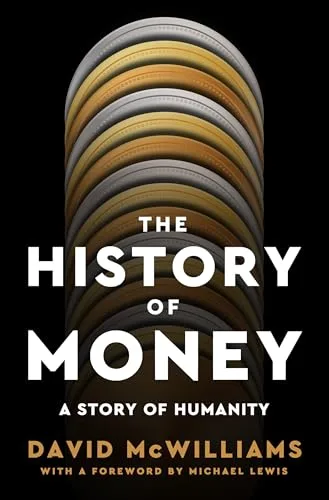
The History of Money
A Story of Humanity
- Published
- 2024
- Pages
- 416 pages
- Publisher
- Henry Holt
- Readers
- 0 members have read this
A former Central Bank of Ireland economist tells 5,000 years of money as a story of trust, credit and power, from Sumerian granaries and debased Roman coins to Florentine bookkeeping, fiat paper, the 2008 crisis and bitcoin. Finance readers get a quick, opinionated account of why money works when people believe in it and breaks when rulers abuse it.
McWilliams treats money as a technology as basic as writing. He argues that writing itself arose to record money, and that better monetary tools came alongside advances in law, mathematics and democracy. The tour starts with a tally stick in ancient Africa and the granaries of Sumer, which made long-term loans much as a central bank would. It ends with commercial-bank money creation, quantitative easing, the 2008 crisis and crypto, which he largely dismisses.
He writes as an insider turned popularizer. McWilliams was a monetary economist at the Central Bank of Ireland and a forecaster for commercial banks before becoming a columnist, podcaster, documentary maker and host of the Kilkenomics festival, which pairs economists with comedians. Chapters are short and the tone chatty; the US edition adds a foreword by Michael Lewis.
What sets the book apart is its humanist frame: it treats monetary economics as a branch of history and culture, so Darwin's debt to Malthus sits next to Roman credit crunches and Nazi counterfeiting. Felix Martin in the FT and the Irish Times were enthusiastic. The caveats are real, though. Larry Elliott in the Guardian was not fully convinced by the grand thesis and found the later chapters on 2008 and bitcoin fairly standard. An IMF Finance & Development review faulted the Eurocentric focus, with China barely covered. The Wall Street Journal's reviewer noted that Hayek and Mises never appear and questioned the book's breezy dismissal of gold.
It is a good first history of money for a new analyst and a lively refresher for anyone who works on rates, currencies or central banks. Readers who want more depth can pair it with Martin's Money: The Unauthorised Biography or Jacob Goldstein's Money: The True Story of a Made-Up Thing.
- Money runs on trust. McWilliams treats credit as a form of trust and money as something that grows more useful the more widely it is used. When a currency fails, look for a failure of trust first.
- Debasement is a slow default. Rome's emperors cut the silver content of their coins to pay their bills and wore away public trust in the state. Modern worries about inflating away debt follow the same pattern.
- Financial plumbing changes how people think. Florence's fractional reserve banking and double-entry bookkeeping did more than move money. The book argues they trained Europe in precise numerical habits ahead of the Age of Reason.
- Banks, not mints, create most money. The chapters on commercial-bank money creation and quantitative easing are the most technical in the book, and they are the ones that matter most for reading central-bank policy and the 2008 crisis.
- Read the fiat case with its critics. McWilliams is pro-fiat and dismissive of gold and crypto, and he cites Keynes far more than his opponents. Pair the book with the Austrian school, which he skips, to test his conclusions.
After a foreword and an introduction, the book runs through five roughly chronological parts, each made up of short thematic chapters.
- Ancient Money. From early tally marks to Mesopotamian clay tablets and Sumerian granaries that lent against the future, then the coins of the Greek world, which gave ordinary people more economic power. Rome's emperors debase the silver coinage and wear away trust in the state, and Imperial Rome suffers its own credit crunch.
- Medieval Money. The Silk Road, mathematics in the medieval Arab world, and Florence, where merchants clash with the Church around the Black Death and develop fractional reserve banking and double-entry bookkeeping.
- Revolutionary Money. Money and credit in the American and French revolutions, with figures such as Alexander Hamilton and Talleyrand, and the 18th-century arrival of fiat paper money, which caused crashes before it helped growth.
- Modern Money. The 19th and 20th centuries through odd angles: Malthus and Darwin, Belgian rubber profits in the Congo, James Joyce's 1909 Dublin cinema, Nazi plans to flood Britain with forged banknotes, and cigarettes used as currency in prisoner-of-war camps.
- Money Unbound. How commercial banks create money, quantitative easing, the 2008 crisis, Kenya's M-Pesa and bitcoin.
Familiar episodes, such as tulip mania in the 1630s and the South Sea Bubble of 1720, appear along the way.
Reader reviews
No reviews yet. Join to write the first one.