
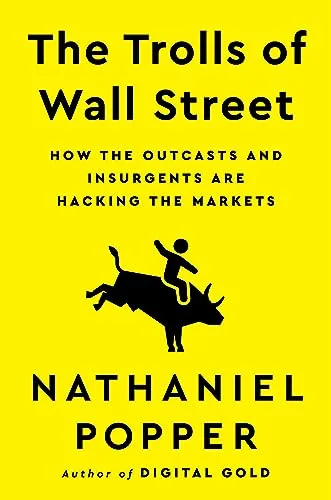
The Trolls of Wall Street
How the Outcasts and Insurgents Are Hacking the Markets
- Published
- 2024
- Pages
- 352 pages
- Publisher
- Dey Street Books
- Readers
- 0 members have read this
A former New York Times finance reporter tells the history of WallStreetBets, the Reddit forum whose members helped drive the 2021 GameStop squeeze. Popper treats it less as David against Goliath than as a refuge for isolated young men, and he shows how memes, zero-commission apps and options trading turned that community into a force in the market.
Popper follows WallStreetBets from its founding in 2012 to the GameStop squeeze and its aftermath. His two central figures are Jaime Rogozinski, the founder, a finance worker from an affluent background who hid his drinking and spent his nights posting, and Jordan Zazzara, a community-college dropout who became a moderator in 2016 and later led the push to remove Rogozinski over his self-promotion. Popper's argument is that the forum's trolling culture, more than any investment thesis, made it a new kind of market participant and changed how a generation thinks about money.
Popper covered finance and technology for the New York Times after stints at the Los Angeles Times and the Forward. His earlier book, Digital Gold, reported on bitcoin's early believers, and that background shows in his handling of online subcultures and crypto.
Ben Mezrich's The Antisocial Network and Spencer Jakab's The Revolution That Wasn't tell the GameStop story head-on. Popper comes at it sideways, through the people and the culture, and does not flinch from the forum's slide into racism, misogyny, Trump fandom and 4chan habits. Publishers Weekly called it evenhanded and one of the more critical accounts of the rally. Kirkus warned that the financial and technical material is dense. Readers who want a straight blow-by-blow of January 2021 may prefer the other books.
It suits brokers, market-structure specialists, short sellers and risk managers who want to understand retail flows as behavior, not just volume.
- Retail flow is part of market structure now. Commission-free apps and online communities turned scattered small accounts into coordinated buying that professionals have to model.
- Options are the amplifier. The forum's appetite for short-dated call options fed gamma squeezes, in which dealer hedging pushed prices further in the same direction.
- Community drives conviction. Popper shows that loneliness, grievance and the hunt for belonging motivated buying as much as profit did, which is why the episode defied conventional valuation logic.
- Crowded shorts are public targets. Heavy short interest in a widely discussed stock became a rallying point. Positioning that is visible to everyone can be attacked by everyone.
- Whoever runs the venue shapes the trade. Battles over moderation and control of WallStreetBets helped decide what it became, a reminder that platforms and their governance matter to market outcomes.
Eighteen chapters move chronologically, from a small subreddit to a market phenomenon that did not fade.
- Origins. In the post-crisis years, Rogozinski starts the forum as a home for high-risk trading talk, and it struggles to survive.
- The culture hardens. Robinhood's rise lowers the cost of trading, and the forum's humor sharpens into 4chan-style trolling and, around 2016, Trump-era politics.
- Detours. Crypto competes for members' attention, and the community absorbs heavy losses and lessons from them.
- The pandemic flood. In 2020 locked-down newcomers pour in, options buying sets off gamma squeezes, celebrity day traders join the frenzy, and moderation fights culminate in Rogozinski's ouster.
- The big squeeze. The GameStop gang forms, trolling reaches a new level and the short squeeze erupts in January 2021.
- Aftermath. The center of the community cannot hold, but the closing chapter argues that the insurgent retail trader is not going away.
Reader reviews
No reviews yet. Join to write the first one.