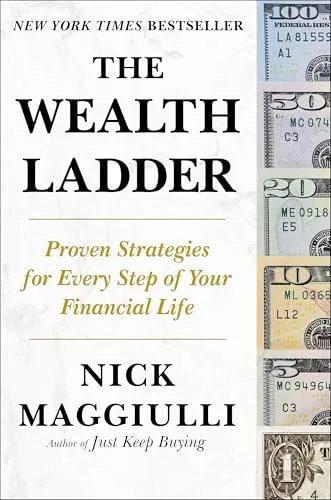
The Wealth Ladder
Proven Strategies for Every Step of Your Financial Life
- Published
- 2025
- Pages
- 256 pages
- Publisher
- Portfolio
- Readers
- 0 members have read this
Nick Maggiulli of Ritholtz Wealth Management argues that most financial advice fails because it ignores where the reader starts. His answer is six wealth levels, each ten times the one before, from under $10,000 to over $100 million, each with its own rules for spending, earning and investing. It is a practical, data-driven framework for anyone advising clients or planning their own money.
Maggiulli's first book, Just Keep Buying, made the case for steady investing. In The Wealth Ladder he concedes that one prescription doesn't fit everyone: buying index funds doesn't help someone buried in debt, and it won't make anyone superrich. So he splits net worth into six levels, each a tenfold jump: under $10,000, $10,000 to $100,000, $100,000 to $1 million, $1 million to $10 million, $10 million to $100 million, and above that.
Each level gets a name tied to spending: paycheck-to-paycheck, then grocery freedom, restaurant freedom, travel freedom, house freedom and finally impact freedom, where money can change other people's lives. The labels rest on what he calls the 0.01% rule, the idea that a purchase worth 0.01 percent of your net worth is trivial. He illustrates it with Jay-Z's line about fifty grand, which in 2011 was roughly that share of the rapper's estimated $450 million fortune.
Maggiulli is an executive at Ritholtz Wealth Management and writes the data-heavy personal finance blog Of Dollars and Data; he studied economics at Stanford. That mix shows in the book, which leans on household wealth data rather than anecdote. William Bernstein's endorsement credits it with describing the human costs of climbing too, and Part III turns to living better rather than just richer.
The limits are those of the genre. The levels are round numbers in US dollars, and most of the tactical advice concerns the first four rungs. No independent critical review could be found to test it. Best for early-career finance professionals, financial advisers and readers who found earlier personal finance books too generic.
- Advice should depend on your level. Maggiulli wrote the book after concluding that his own keep-buying advice did not fit readers deep in debt or those chasing great wealth; the right move depends on the starting rung.
- Use the 0.01% rule. Spending that equals about 0.01 percent of net worth won't affect long-term wealth, which gives a simple test for which decisions deserve attention.
- Each rung is a tenfold jump. Thinking in orders of magnitude clarifies what it actually takes to move up, and why the same habits produce different results at different levels.
- Freedom comes in stages. Each rung buys a new kind of spending freedom, from groceries to restaurants, travel, a dream house and finally the ability to change other lives, a useful way to set realistic goals.
- More rungs aren't free. Maggiulli argues that the higher levels bring costs of their own, so deciding where to stop is part of the plan.
The book is short, about 214 pages of text across 14 chapters in three parts, by the author's count.
- Part I: The framework. Maggiulli introduces the six wealth levels, defined by net worth, and opens with Spending up the Wealth Ladder, which uses Cleopatra's pearl and the 0.01% rule to show that what counts as expensive depends on your wealth.
- Part II: Level by level. He works through each rung, from paycheck-to-paycheck through grocery, restaurant and travel freedom, setting out what to focus on and what to avoid at each, including how spending, income and investment priorities shift as wealth grows tenfold.
- Part II, continued: the top rungs. At levels five and six, house freedom and impact freedom, the questions shift from accumulation to what money is for, including buying businesses and large-scale philanthropy.
- Part III: A better life, not just a richer one. The closing section asks how to use the ladder to decide how much is enough, which level is most likely to make you happy, and what the higher levels cost in personal terms.
Reader reviews
No reviews yet. Join to write the first one.