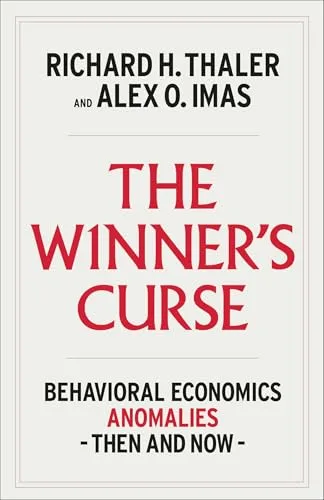
The Winner's Curse
Behavioral Economics Anomalies, Then and Now
by Richard H. Thaler and Alex O. Imas
- Published
- 2025
- Pages
- 352 pages
- Publisher
- Simon & Schuster
- Readers
- 0 members have read this
Nobel laureate Richard Thaler and Chicago Booth economist Alex Imas take the Anomalies columns that launched behavioral economics and test each one against 30 years of later research. This is a new book, not a reprint of Thaler's 1992 collection. For investors it covers why auction winners overpay, why people overvalue what they own, and which market anomalies have held up.
Starting in 1987, Richard Thaler wrote a column called Anomalies for the Journal of Economic Perspectives. Each installment documented a pattern of behavior that standard economic theory could not explain. In 1992 he collected the columns as The Winner's Curse: Paradoxes and Anomalies of Economic Life. This 2025 book is a new work built on that one, written with Alex Imas. Each chapter reprints an original column nearly verbatim, then adds a substantial update on what three decades of research have found, with new notes and a closing epilogue.
The authors carry weight. Thaler won the 2017 Nobel prize in economics and wrote Nudge with Cass Sunstein, and Misbehaving. Imas is a professor of behavioral science, economics and applied AI at Chicago Booth and a Sloan Research Fellow. A companion website, thewinnerscurse.org, offers teaching slides and materials for replicating the experiments.
Its distinctive move is the then-and-now format. Many behavioral findings in psychology failed to replicate. The authors report that the core economic anomalies largely hold, and that many show up outside the lab, from retirement saving and credit card debt to portfolio management and meme stocks. They also take on economists who explain the results away as confused subjects, and concede that no single theory has replaced the rational model.
Publishers Weekly praised the clear prose and noted a few equations. ProMarket and the Society of Professional Economists called it accessible to non-economists. The Financial Times named it one of the best books of 2025. Readers of Misbehaving will recognize some stories, but anyone who prices risk, bids in auctions or does M&A will learn from it.
- Winning an auction is a warning sign. In common-value bidding, the highest bid often comes from whoever overestimated the asset most. Acquirers in contested deals should shade their bids.
- Ownership changes valuation. The endowment effect and loss aversion lead holders to demand more than they would pay, which helps explain sticky positions and thin trading.
- The anomalies replicate. Unlike many psychology results, the core findings have held up over 30 years and appear in field data, not just student experiments.
- Defaults drive outcomes. Status quo bias means the option chosen for people, whether in retirement plans or insurance, shapes behavior more than incentives do.
- Rational models remain a baseline. The standard model is still useful as a benchmark, but the authors argue no single replacement theory is likely, so pricing human error remains case by case.
Twelve chapters follow the same two-part design: the original Anomalies column as first published, then an update reviewing the research since.
- Cooperation and fairness. Public-goods and bargaining experiments where people cooperate or punish unfairness even when free riding would pay more, and the confused-subjects explanation the authors reject.
- The winner's curse. Why the winning bidder in common-value auctions tends to overpay, from oil-field leases to takeover contests. One study the update cites finds that losers of bidding wars outperformed the winners by 24% in later stock returns.
- Ownership and loss aversion. The endowment effect, where people demand more to give up a coffee mug than they would pay to buy it, along with loss aversion and status quo bias, now seen in real-world defaults such as health insurance choices.
- Preference reversals and time. Choices that flip depending on how they are framed or elicited, and present bias, where people discount the near future far more steeply than the distant future.
- Markets and the law of one price. Anomalies that challenge efficient-market assumptions and show up in portfolio management and retail trading.
- Epilogue. Whether behavioral economics has changed how economics is taught, and why the authors doubt a single general theory will replace the standard model.
Reader reviews
No reviews yet. Join to write the first one.