
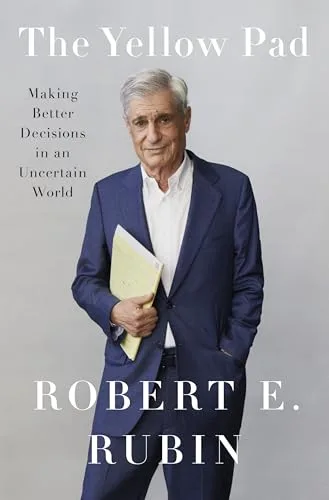
The Yellow Pad
Making Better Decisions in an Uncertain World
- Published
- 2023
- Pages
- 336 pages
- Publisher
- Penguin Press
- Readers
- 0 members have read this
The former Goldman Sachs co-senior partner and Treasury secretary explains the probabilistic method he has used for six decades: write down the possible outcomes, assign odds, and choose on expected value. Part decision manual and part memoir, it shows how a risk arbitrageur's habits carried over to crisis management in Washington.
Rubin's starting point is a 1958 philosophy class at Harvard, where Raphael Demos taught him that nothing is certain. Ever since, he says, he has made big decisions by writing outcomes and their odds on a yellow legal pad and weighing the expected value. The book applies that habit to investing, managing people, economic policy and the big public questions he thinks the country is handling badly, from deficits to climate change.
Few authors have Rubin's range of seats: 26 years at Goldman Sachs, rising from risk arbitrage to co-senior partner; first director of the National Economic Council; 70th Treasury secretary from 1995 to 1999; then senior counselor and board member at Citigroup. His first book, In an Uncertain World (2003), told the career story; this one is organized around the method.
The best material is concrete. The opening chapter recounts a talk at San Quentin, a friend who sold every stock after the 2016 election, and the 1995 Mexico rescue, which Rubin and Larry Summers nearly abandoned until Leon Panetta's objections prompted them to rerun the expected-value math. Mexico repaid its loans in full with interest. Bloomberg named it one of the best books of 2023.
Publishers Weekly judged it earnest but flawed: dry prose, anecdotes that wander from the theme, and a book torn between memoir and manual. Readers should also know that Rubin's Citigroup years, which ended after the bank's 2008 federal rescue, remain contested; he has said he did not foresee how severe the crisis would be. Best for risk managers, portfolio managers and anyone who sits on an investment committee.
- Write down the odds. Listing possible outcomes and assigning rough probabilities forces you to confront uncertainty instead of acting on a single expected scenario. The yellow pad is a discipline, not a formula.
- Respond, don't react. In a crisis, the urge is to act as if the worst case is certain. Rubin's friend who sold his whole portfolio after the 2016 election treated a possible crash as a sure thing; a partial hedge would have matched the real odds.
- Know your own bias and correct for it. Rubin knows he overweights risk, so he checks whether he is overestimating bad outcomes. Investors who are too comfortable with risk need the opposite check.
- Ask for the other point of view. The Mexico rescue nearly ended until Leon Panetta pushed back and Rubin and Summers reran the analysis. Seeking out disagreement improves decisions even when the dissenter's reasons are different from yours.
- Judge decisions apart from outcomes. A good process can produce a bad result and a reckless bet can pay off. Over many decisions, sound expected-value reasoning wins and lucky streaks end.
The book has eleven chapters and a conclusion, moving from the method itself to markets, organizations and public policy.
- Reacting versus responding. The first chapter sets out the core idea through a talk Rubin gave at San Quentin, the danger of acting as if one outcome were certain in moments of extreme disruption, and the 1995 Mexico rescue as a case study in group decision-making.
- Lessons from the trading desk. Rubin draws on his Goldman Sachs years, from the risk arbitrage desk to the shock of a partner's arrest for insider trading, to show how probabilistic thinking works when real money is at stake.
- Managing people. He describes changing his approach to colleagues as he moved from arbitrage into management, and how leaders can draw out dissent rather than consensus.
- Policy-making. Drawing on his years at the National Economic Council and the Treasury, Rubin applies the same cost-benefit and probability habits to economic policy, including deficits and fiscal choices.
- The hard questions. The later chapters, including one titled An Email from Eliza, apply the framework to issues such as public investment, taxes, crime, climate change and the health of American democracy, before a conclusion on staying open-minded.
Reader reviews
No reviews yet. Join to write the first one.