
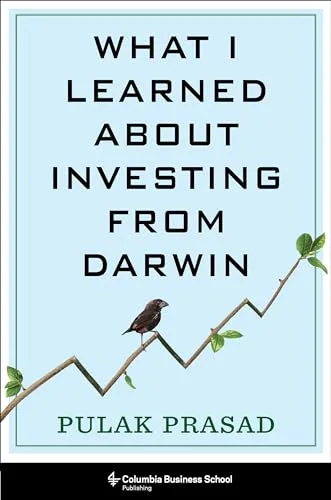
What I Learned About Investing from Darwin
by Pulak Prasad
- Published
- 2023
- Pages
- 328 pages
- Publisher
- Columbia Business School Publishing
- Readers
- 0 members have read this
The founder of Nalanda Capital, which manages about $5 billion in listed Indian stocks, uses evolutionary biology to argue for a very patient strategy: avoid big risks, buy high-quality businesses at fair prices and then hold them almost forever. It is a quality-investing manual built on foxes, frogs and sea urchins instead of spreadsheets.
Pulak Prasad starts from a familiar problem: most active equity managers fail to beat the market over long periods. His answer is to borrow from evolutionary biology. Each chapter pairs a natural phenomenon with an investing principle, opens with quotes from Darwin and Warren Buffett and closes with a summary. The Siberian fox-breeding experiment that began in 1959, where breeding only for tameness produced a cascade of other traits, becomes his case for focusing on one metric, return on capital employed, that tends to travel with good management and durable advantage.
Prasad founded Singapore-based Nalanda Capital after co-heading India for Warburg Pincus and working at McKinsey. Many examples come from his own portfolio, including mistakes, which gives the book a practitioner's credibility.
The book is organized around three rules: avoid big risks, buy high quality at a fair price and be very lazy. Along the way he takes aim at EBITDA, discounted cash flow models, forward estimates and the false precision of much professional analysis, and he ends with a candid scorecard of Nalanda's winners and failures. CFA Institute's reviewer praised the clear writing and vivid examples but flagged a few slips, awkward jokes and a dislike of debt that sits uneasily with buy-and-hold, since debt-free companies can become buyout targets. Theory-heavy passages may lose beginners, and Prasad concedes that a backward-looking ROCE filter will miss late bloomers such as Eicher or Tesla.
It suits long-only and family-office investors, and anyone who wants a structured argument for doing less.
- Be a great rejector. In Prasad's illustration, cutting errors of commission lifts the success rate far more than also avoiding errors of omission, so saying no is the core skill.
- One good metric beats many. Like tameness in the fox experiment, high historical return on capital employed tends to come bundled with strong management, sound capital allocation and competitive advantage.
- Separate ultimate from proximate causes. Macro, market and thematic shocks can swing a stock without changing the long-run economics of the business, and those swings are where patient buyers get their prices.
- Pay for delivered results. Nalanda skips DCF models and forward estimates, distrusts EBITDA and management guidance, and pays a fair multiple on what a company has already earned.
- Let the winners carry the losers. The book counts seven failures among 17 businesses, yet Page Industries alone returned 82.2 times its cost, more than five times the total put into the failures, which is the case for rarely selling.
After an introduction on why most fund managers lag the market, the book follows its three principles in three parts and ten chapters.
- Part I: Avoid big risks. Oh, to Be a Bumblebee separates errors of commission from errors of omission. Prey animals, like a deer that skips a watering hole where a cheetah may hide, show why cutting bad investments matters far more than catching every winner.
- Part II: What to buy. The Siberian Solution makes historical ROCE the single starting filter. The Paradox of McKinsey and Sea Urchins is about robustness. The Perils of a Pavlovian separates the ultimate causes of business success from the proximate shocks that move share prices.
- Part II: How to buy. Darwin Ate My DCF explains why Nalanda makes no projections and pays a fair multiple on delivered results. Bacteria and Business Replay the Tape looks for recurring business templates, such as Info Edge's lead in online recruitment. Don't Confuse a Green Frog for a Guppy warns against false signals from guidance, roadshows and headlines.
- Part III: Very lazy. Three chapters argue for rarely trading, drawing on punctuated equilibrium and a rereading of Fortune 500 survival data. They treat crises such as Covid as buying opportunities and close with Nalanda's record of hits and misses.
Reader reviews
No reviews yet. Join to write the first one.