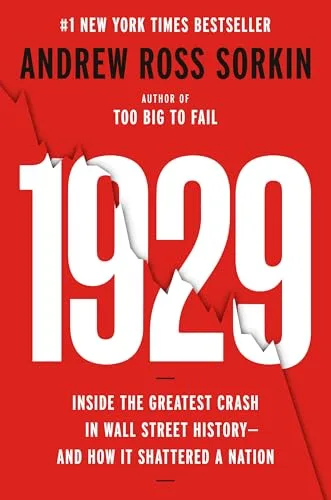
1929
Inside the Greatest Crash in Wall Street History—and How It Shattered a Nation
- Published
- 2025
- Pages
- 592 pages
- Publisher
- Viking
- Readers
- 0 members have read this
Andrew Ross Sorkin spent eight years in the archives to rebuild the 1929 crash scene by scene, through the bankers, speculators and officials who fed a margin-driven boom and then could not stop the fall. For finance readers it is a case study in leverage, conflicted banks and a hesitant central bank, and the lessons carry over to any market that runs on borrowed money.
The story runs from February 1929, seven months before the top, to June 1933. Banks lent call money that let investors buy stock with as little as 10 percent down, and the Dow closed at its peak of 381.17 on September 3, 1929. Sorkin's argument is that the crash was a human event. Bankers such as Charles E. Mitchell of National City Bank and Thomas W. Lamont of the House of Morgan had too much riding on the boom to imagine it ending. The Federal Reserve, urged by Herbert Hoover to restrict credit, held back on rate increases for fear of setting off a panic.
Sorkin founded The New York Times's DealBook, co-anchors CNBC's Squawk Box and co-created Billions. His Too Big to Fail won the 2010 Gerald Loeb Award. Here he swaps live sources for documents, many of them previously unpublished, and backs the narrative with about 100 pages of notes and a cast of characters.
The obvious comparison is John Kenneth Galbraith's The Great Crash, 1929, and the critics' main complaint is that Sorkin follows Galbraith too closely. Amity Shlaes, in the Coolidge Review, said he treats speculation and greed as the cause and the Depression as their inevitable result, and passes over Milton Friedman, Anna Schwartz and later work on policy mistakes. James Dorn of the Cato Institute praised the research but said it neglects the Fed and the contraction of the money supply. Zachary Carter, in The New York Times, came at it from the left: he read Sorkin's sympathy for the bankers as an indictment of the system, since small investors bore the losses. The book was a Times notable book of 2025 and reached No. 2 on its bestseller list.
Read it if you work with margin, bank balance sheets or market structure. For the monetary side of the story, pair it with Friedman and Schwartz.
- Leverage sets the size of the fall. Call loans and 10 percent margin turned an overvalued market into a forced-selling cascade. Know how much borrowed money sits under any rally you own.
- Insiders are the last to see the top. Mitchell and Lamont had so much tied to the boom that they could not take bearish scenarios seriously. Discount bullish calls from people whose firms profit from the bull market.
- Central banks can freeze up. The Fed saw the bubble but hesitated to raise rates for fear of causing a panic, which shows how policy timing can matter as much as policy direction.
- Warnings come early and get ignored. Babson called the crash weeks ahead and Livermore profited from his view. Being right about valuation is not the same as being right about timing, but extreme leverage shortens the wait.
- Know which story of 1929 you are using. Sorkin stresses speculation and human nature, while his critics point to monetary contraction and 1930s policy errors. The lesson you draw for today's markets depends on which cause you think mattered most.
The book moves forward through dated scenes, from February 1, 1929 to June 1933, cutting between Wall Street, Washington and the Federal Reserve.
- The boom. Easy call money, margin as thin as 10 percent and stock pools run by operators such as William C. Durant push prices up. Mitchell, Lamont and other bankers stay bullish.
- The policy standoff. Hoover wants credit tightened. The Fed worries that higher rates will trigger the panic it is trying to avoid, and debates while speculation grows.
- The top and the warnings. The Dow peaks at 381.17 on September 3. Two days later Roger Babson warns of a crash and the market drops sharply. Jesse Livermore, who had judged stocks overpriced, bets against them.
- The crash. The October sell-offs, ending with Black Tuesday, wipe out leveraged investors. Livermore reportedly makes about $100 million on the way down.
- The aftermath. Bank failures, the collapse of consumer credit and the slide into the Great Depression. The story closes in 1933 as Washington rewrites the rules for banking and creates deposit insurance.
Reader reviews
No reviews yet. Join to write the first one.