
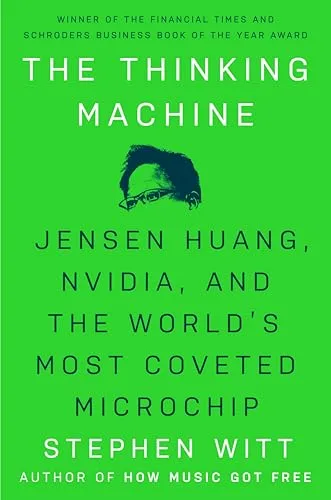
The Thinking Machine
Jensen Huang, Nvidia, and the World's Most Coveted Microchip
by Stephen Witt
- Published
- 2025
- Pages
- 272 pages
- Publisher
- Viking
- Readers
- 0 members have read this
Winner of the 2025 FT and Schroders Business Book of the Year. Stephen Witt tells how Nvidia went from a Denny's booth and a near-fatal first chip to the most valuable company on earth. Built on rare access to Jensen Huang and his circle, it shows investors why a stock that went nowhere for more than a decade became the main bet on artificial intelligence.
In June 2024, three decades after its founders sketched the company at a Denny's in San Jose, Nvidia passed Microsoft and Apple to become the world's most valuable company. The launch of ChatGPT had set off a rush to buy AI computing power. Stephen Witt explains how a maker of video game graphics chips ended up selling those picks and shovels. His answer centers on Jensen Huang, who bet the company on parallel computing and then, around 2013, on neural networks, years before Wall Street saw any payoff.
Witt is a New Yorker contributor whose first book, How Music Got Free, was shortlisted for the FT business book prize in 2015. This one won it in 2025, ahead of Abundance, Chokepoints and Breakneck. He interviewed Huang at length, along with his friends, employees and investors. The Economist named it a best book of 2025, and the New York Times called the rise of the hottest stock on Wall Street a fascinating story.
The markets thread is what finance readers should watch for. As Marc Levinson noted in the Wall Street Journal, a share bought at the start of 2002 was worth about two-thirds of its cost a dozen years later, while one bought a decade before the review was up roughly 200-fold. In between came near-death moments, a 2002 SEC investigation that forced a three-year earnings restatement, product fiascos, and a CEO who defied analysts to keep funding a bet the market did not value.
Levinson found the history incomplete because Witt lacked access to company archives. The Times reviewer was left unsure what Huang's vision for AI actually is. Levinson also found it less admiring of Huang than most accounts, and clear on parallel processing and large language models for lay readers. Read it to understand the company that now anchors the index and the AI trade.
- Great stocks can go nowhere for years. A share bought at the start of 2002 was still worth only about two-thirds of its cost 12 years later, a lesson in how long a thesis can take to work and how few holders stay with it.
- Survival comes before strategy. Nvidia nearly died in its first years. Huang's insistence that it was always 30 days from failure shaped a culture of speed and paranoia.
- Long-dated options look like waste at first. Spending on general-purpose GPU computing and neural networks looked unprofitable for years. The market valued it only once demand arrived.
- Governance risk and founder power go together. A 2002 SEC probe, a restatement and a CEO with dozens of direct reports and a fierce temper are the other side of founder control.
- Demand booms concentrate value. When ChatGPT set off a race for computing power, the scarce supplier captured the gains, which is why one chip designer came to weigh so heavily in the indexes.
Witt tells the story mostly in chronological order, from Huang's childhood to the AI boom and the questions it raises.
- Origins. Huang was born in Taiwan in 1963 and sent to the United States as a boy, where a relative's mix-up placed him at a Kentucky school for troubled youths. He went on to Oregon State, AMD and LSI Logic, and became a table tennis champion along the way.
- Founding and near-death. In 1993 Huang, Chris Malachowsky and Curtis Priem started Nvidia with venture backing. Its first chip flopped and most of the staff were laid off. A 1997 product arrived just before the cash ran out, giving Huang his motto that the company is always 30 days from going out of business.
- Boom, IPO and stumbles. The 1999 GeForce hit and the IPO were followed by a failed GeForce revision, an ill-fated communications chip, a 2002 SEC investigation and restatement, and a 2006 product for scientific computing that flopped.
- The AI bet. Bryan Catanzaro, a researcher whose neural-network work was close to a poor performance review, persuades Huang that AI is advancing fast. Around 2013 Huang turns Nvidia toward machine learning, using the parallel-computing base it had built.
- The world's most valuable company. ChatGPT sets off a scramble for Nvidia hardware, the stock soars, and Huang becomes one of the richest people alive. The book closes on an uneasy look at AI's risks, a subject Huang bristles at.
Reader reviews
No reviews yet. Join to write the first one.