
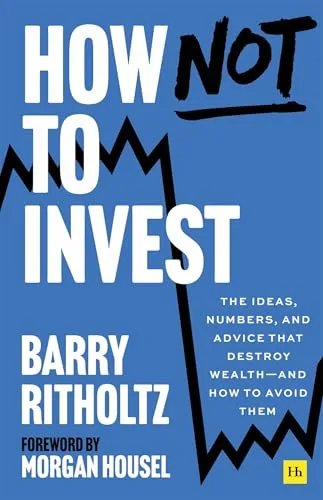
How Not to Invest
The Ideas, Numbers, and Behaviors That Destroy Wealth—and How to Avoid Them
- Published
- 2025
- Pages
- 496 pages
- Publisher
- Harriman House
- Readers
- 0 members have read this
Ritholtz has run money and written about markets for more than two decades, and he hosts Bloomberg's Masters in Business. Here he lists the mistakes that cost investors the most, sorted into bad ideas, bad numbers and bad behavior. His case is that avoiding unforced errors beats chasing brilliance, and the advice on forecasting, yield-chasing and concentrated stock positions applies to professionals as much as to savers.
Most investing books promise an edge. Barry Ritholtz offers the opposite: a field guide to the errors that destroy wealth, built on the argument, in the tradition of Charles Ellis's Winning the Loser's Game, that investors win mostly by not losing. The result is a long, well-organized catalog of forecasts, media noise, misread statistics and self-defeating behavior, followed by a short prescription.
Ritholtz writes from inside the business. He co-founded Ritholtz Wealth Management in 2013 and serves as its chairman and chief investment officer. He started The Big Picture, one of the first market blogs, in 2003, and has hosted Bloomberg's Masters in Business for years. His earlier book, Bailout Nation, covered the 2008 crisis. Morgan Housel wrote the foreword, and Ray Dalio, Jack Schwager and former Vanguard chief Bill McNabb endorsed the book.
The book stands out for its range of examples: the Belfer family, billionaires who were burned by Enron, then Madoff, then FTX; a much-publicized layoff of 18,000 at Amazon that was about 1% of its workforce; and the 508-point drop of 1987, which was 22% then and would be about 1% today. He also lists 20 financial innovations that helped investors, a reply to Paul Volcker's quip that the ATM was the only useful one.
Reviewers had reservations. Michael J. Wiener questioned some of the behavior-gap data. He also found the discussion of secular P/E cycles hard to act on, and the satellite and mad-money allocations missing a plan for when those bets lose. Adam Grossman noted that the prescription is the shortest section. The book is aimed at individual investors and advisors, but anyone starting on a desk will pick up useful habits from it.
- Plan for ranges, not forecasts. Because no one can forecast reliably, a portfolio should hold up across many outcomes rather than depend on one call being right.
- Check the denominator. An 18,000-person layoff at a company of about 1.5 million, or a 508-point Dow drop, means little until you scale it.
- Owning everything captures the winners. A very small fraction of stocks drives all net market gains, so a broad index fund owns them without having to find them in advance.
- Yield-chasing has three forms. Longer duration, weaker credit and leverage can each turn a reach for income into a capital loss.
- Decide in advance how to sell a windfall. For a concentrated position, compare holding while it falls to a tenth of its value with selling half before it rises tenfold. The regret is lopsided, so selling some is the rational choice.
After a foreword by Morgan Housel and a preface on being consistently not stupid, the book is organized into four parts.
- Bad Ideas. Sections on poor advice, media madness and the study of bad ideas. Nobody, experts included, can reliably forecast. Strategist outlooks are mostly marketing. Plans should be built for a range of outcomes rather than a single prediction.
- Bad Numbers. Economic innumeracy, market mayhem and stock shocks. This part covers denominator blindness, survivorship bias, the limits of models and the pull of anecdotes over data. It also explains why the hardest-hit Covid industries barely moved the S&P 500, and why a tiny share of listed stocks produces all the market's net gains.
- Bad Behavior. Avoidable mistakes, emotional decision-making and cognitive deficits. It names three ways to chase yield (longer duration, lower credit quality and leverage). It separates risk from uncertainty, following Michael Mauboussin, and explains why investors call themselves aggressive after rallies and conservative after declines.
- Good Advice. A short checklist: avoid mistakes, build around low-cost index funds, own some bonds, doubt most alternatives, use a fiduciary, and keep any speculation in a small, ring-fenced account.
Reader reviews
No reviews yet. Join to write the first one.