
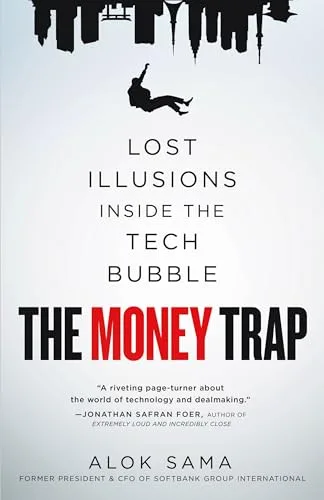
The Money Trap
Lost Illusions Inside the Tech Bubble
by Alok Sama
- Published
- 2024
- Pages
- 304 pages
- Publisher
- St. Martin's Press
- Readers
- 0 members have read this
A longtime Morgan Stanley banker who became SoftBank's chief dealmaker and a top adviser to Masayoshi Son recounts the tech-bubble deals, the boardroom rivalries and a covert smear campaign that drove him out. It gives an insider's view of how mega-deals get done and argues that more money does not buy more control.
Alok Sama spent much of his career at Morgan Stanley before joining Masayoshi Son at SoftBank, where he became the group's chief dealmaker and later president and CFO of SoftBank Group International. That job put him at the center of a group whose portfolio includes Arm, Yahoo, Nvidia, TikTok, Uber, T-Mobile, Alibaba and WeWork, and in negotiations held on a private jet, in a Japanese garden and at a restaurant on the Turkish coast.
The book opens like a thriller. Sama is threatened with blackmail and meets two former Mossad agents in London, who warn him of a plot to remove him from his job and ask for a million dollars to stop it. That smear campaign, which included surveillance of his family, becomes the climax and pushes him out of tech investing. Around it he sets the deal stories, Son's enthusiasms for figures such as WeWork's Adam Neumann, a dinner with Mark Zuckerberg, and the deaths of his parents.
Kirkus found him funny, self-aware and often rueful, and praised his clear explanations of derivatives and of Amazon's consumer proposition, while finding the pacing bumpy. Publishers Weekly called it a wry debut but warned that long passages on Nasdaq figures and deal mechanics will lose all but well-versed readers. The narrative also moves back and forth in time, which PW noted and which can make the deal chronology hard to follow.
Read it alongside Lionel Barber's Gambling Man for a view of SoftBank from inside Son's inner circle.
- Deals are personal. Sama shows that mega-deals turn on relationships, settings and a principal's moods as much as on models and term sheets.
- Founder enthusiasm is a risk factor. Son's attraction to charismatic founders like Adam Neumann illustrates how conviction at the top can overwhelm diligence.
- Power invites attack. The smear campaign against Sama shows how fights over control of a large investment group can turn to surveillance and intimidation.
- Bubbles reward and punish the same bets. The Yahoo stake that soared before the dot-com crash is a reminder that paper gains in a bubble can vanish quickly.
- Money does not buy control. Sama's own conclusion is that wealth makes life more comfortable but does not shield anyone from loss, grief or other people's agendas.
Sama moves back and forth in time, so the book reads as linked threads rather than a straight chronology.
- The threat. The opening scenes put him in London with two former Mossad agents who describe a plot against him, setting up the smear campaign that runs through the book.
- From theorems to Morgan Stanley. He traces his path from a maths-minded student to a long career as an investment banker, and his sense of being undervalued there.
- Inside SoftBank. Joining Son, he works on the group's biggest deals and describes Son's history, including the early Yahoo stake that soared before the dot-com crash, and his eccentric and not always successful enthusiasms.
- The tech bubble. SoftBank's money floods ride-sharing and other start-ups, Son falls for WeWork's Adam Neumann, and Sama meets founders and heads of state while many bets go wrong.
- The reckoning. The smear campaign escalates to surveillance of his family as he grieves his parents, and he leaves tech investing concluding that money buys comfort, not control.
Reader reviews
No reviews yet. Join to write the first one.