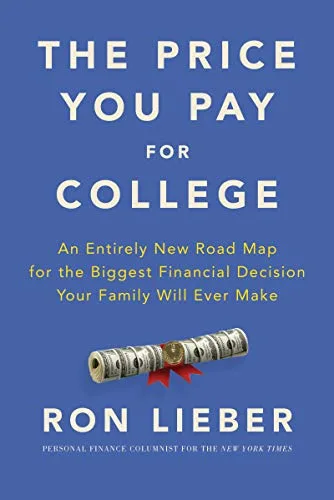
The Price You Pay for College
An Entirely New Road Map for the Biggest Financial Decision Your Family Will Ever Make
by Ron Lieber
- Published
- 2021
- Pages
- 336 pages
- Publisher
- Harper
- Readers
- 2 members have read this
New York Times Your Money columnist Ron Lieber explains how colleges actually set prices, why the sticker price is often fiction, and how merit aid works as a discount used to win students. It is the clearest consumer guide to a purchase that can cost nearly $350,000 at a top school, and it treats tuition as an investment decision with a price, a return and room to negotiate.
Lieber starts from the observation that no consumer decision produces more confusion and emotion than what to pay for college. He explains who pays what and why, how financial aid became so complicated, and how merit aid works less as a reward for talent than as a targeted discount colleges use to recruit the students they want. He then asks the harder question of what families are buying: which features of a school actually matter, from its size and who does the teaching to what its career center can deliver, and when a famous name is worth the premium.
The author writes the Your Money column for the New York Times, has won three Gerald Loeb Awards, including one for reporting on student debt, and wrote The Opposite of Spoiled. He presents the book as the culmination of 15 years of personal finance reporting for the Times and the Wall Street Journal.
Kirkus called it a revealing and useful guide and noted Lieber's estimate that a degree still returns about 14 percent a year, roughly double what stocks usually return, along with his account of why prices climbed, from cuts in state funding to the salaries of professors and administrators. Much of the book's value lies in the questions it teaches parents to put to college presidents and financial aid staff, questions families often avoid asking.
For finance readers who are also parents, it offers a fluent explanation of a complicated pricing system and a reminder that the list price is only an opening offer.
- The sticker price is an opening bid. Many colleges discount heavily through merit aid, so the published tuition says little about what a given family will actually pay.
- Merit aid is a pricing tool. Schools use it to compete for the students they want, which gives families whose children are attractive applicants real leverage.
- Know how the formulas see you. Need-based aid follows formulas that decide what a school expects a family to contribute, and understanding them before applying shows what you will be asked to pay.
- Ask what you are buying. Before paying a premium, compare schools on what affects outcomes and well-being, such as size, who does the teaching and what the career center delivers, not reputation alone.
- Ask for a better deal. Aid offers can be appealed and compared across schools. The worst answer is no.
The book moves from how the pricing system works, to what families are paying for, to how to pay.
- How college pricing works. Lieber traces why prices have climbed, including cuts in state funding and the salaries of professors and administrators, and explains who pays what and how financial aid became so complicated.
- The merit aid game. He pulls back the curtain on merit scholarships, showing how colleges use them as discounts to compete for students and why the discount often matters more than the published tuition.
- Judging value. Chapters weigh what a school actually delivers, from its size and who teaches the classes to the claims its career center makes, drawing on the limited research on what matters, and ask when prestige is worth paying for.
- Other paths. Lieber looks at community college as a cheaper start, with attention to whether credits transfer, and at military service and the GI Bill, with cautions about enlisting for financial reasons alone.
- Paying and bargaining. He closes with practical advice on setting financial goals, saving, borrowing, and going back to colleges to negotiate a better offer.
The hugely popular New York Times Your Money” columnist and author of the bestselling The Opposite of Spoiled offers a deeply reported and emotionally honest approach to the biggest financial decision families will ever make: what to pay for college. Sending a teenager to a flagship state university for four years of on-campus living costs more than $100,000 in many parts of the United States. Meanwhile, many families of freshmen attending selective private colleges will spend triple—over $300,000. With the same passion, smarts, and humor that infuse his personal finance column, Ron Lieber offers a much-needed roadmap to help families navigate this difficult and often confusing journey. Lieber begins by explaining who pays what and why and how the financial aid system got so complicated. He also pulls the curtain back on merit aid, an entirely new form of discounting that most colleges now use to compete with peers. While price is essential, value is paramount. So what is worth paying extra for, and how do you know when it exists in abundance at any particular school? Is a small college better than a big one? Who actually does the teaching? Given that every college claims to have reinvented its career center, who should we actually believe? He asks the tough questions of college presidents and financial aid gatekeepers that parents don’t know (or are afraid) to ask and summarizes the research about what matters and what doesn’t. Finally, Lieber calmly walks families through the process of setting financial goals, explaining the system to their children and figuring out the right ways to save, borrow, and bargain for a better deal. The Price You Pay for College gives parents the clarity they need to make informed choices and helps restore the joy and wonder the college experience is supposed to represent.
Reader reviews
No reviews yet. Join to write the first one.