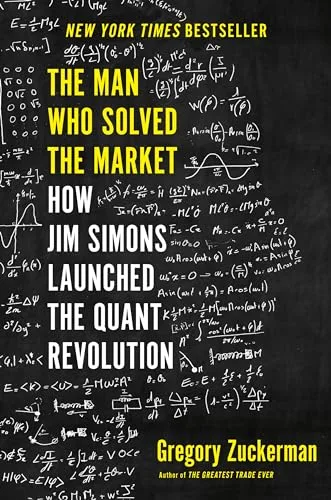
The Man Who Solved the Market
How Jim Simons Launched the Quant Revolution
- Published
- 2019
- Pages
- 384 pages
- Publisher
- Portfolio
- Readers
- 5 members have read this
The first full account of Jim Simons and Renaissance Technologies, the code breaker and math professor whose Medallion fund produced the best long-run record in investing. Zuckerman shows how a team of mathematicians, physicists and computer scientists, not Wall Street veterans, turned pattern-finding in market data into a money machine.
Jim Simons broke codes for the Institute for Defense Analyses and built a math department at Stony Brook before leaving academia to trade. Zuckerman's subject is how Simons and his recruits built Renaissance Technologies, whose Medallion fund compounded at a pace no other investor has matched, through statistical models that ignored why prices moved and only asked whether a pattern repeated.
Zuckerman, a longtime Wall Street Journal reporter and author of The Greatest Trade Ever about John Paulson, reconstructed the story from more than 400 interviews with more than 30 current and former Renaissance employees, plus friends, family and rivals, and, late in the project, with Simons himself, who would not discuss the firm's secret methods. Appendices rebuild Medallion's returns and compare them with those of Buffett, Soros and other investors, which reviewers singled out as new information. The book was shortlisted for the 2019 Financial Times and McKinsey Business Book of the Year.
The book also covers what the money did to the firm and its people, above all Robert Mercer. Critics noted limits: the title overstates Simons's priority, since other quants were working earlier, and the trading methods stay largely a black box.
Anyone who works in or competes with systematic investing should read it, along with anyone who wants to understand why data, talent and culture beat a single clever idea.
- The why can wait. Renaissance traded patterns that held up statistically even when no one could explain them, a sharp break from fundamental and macro investing.
- Hire outside finance. Simons recruited mathematicians, physicists and speech-recognition researchers rather than traders, and treated markets as a data and signal-processing problem.
- Small edges, many bets. Medallion's returns came from being right slightly more often than wrong across a very large number of short-term trades, not from a few big calls.
- Override the model at your peril. Several early partners left over Simons's habit of second-guessing the system, and the fund only took off once discretion was squeezed out.
- Capacity is a constraint. Renaissance kept Medallion small and closed it to outsiders, while its larger funds open to clients did far less well, a reminder that the best strategies rarely scale.
The book is told chronologically in two parts, with an introduction and appendices on Medallion's returns.
- Money isn't everything. Simons's childhood in Massachusetts, his mathematics career, his code-breaking work and his dismissal from the IDA after speaking out against the Vietnam War, and his years leading the Stony Brook math department.
- First attempts at trading. Simons starts Monemetrics in 1978 and works with Leonard Baum and later James Ax, mixing models with gut calls and riding big currency and commodity moves, with painful drawdowns along the way.
- Medallion takes shape. Elwyn Berlekamp, Henry Laufer and others push the fund toward short-term, fully systematic trading around 1990, and the results begin to compound.
- Money changes everything. Peter Brown and Robert Mercer arrive from IBM in 1993, rebuild the stock-trading system, and eventually run the firm as Medallion closes to outside investors.
- Wealth, politics and fallout. Mercer's backing of Breitbart, Cambridge Analytica and Trump splits the firm, while Simons turns to philanthropy and the quant methods he pioneered spread across Wall Street.
Bestselling author and veteran Wall Street Journal reporter Zuckerman answers the question investors have been asking for decades: How did Jim Simons do it? Simons is the greatest money maker in modern financial history. His track record bests those of legendary investors including Warren Buffett, Peter Lynch, Ray Dalio, and George Soros..
Reader reviews
No reviews yet. Join to write the first one.