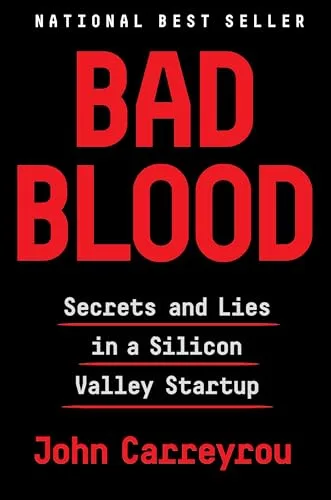
Bad Blood
Secrets and Lies in a Silicon Valley Startup
- Published
- 2018
- Pages
- 339 pages
- Publisher
- Alfred A. Knopf
- Readers
- 5 members have read this
The Wall Street Journal reporter who exposed Theranos tells how Elizabeth Holmes raised more than $700 million and reached a valuation of about $9 billion for blood-testing technology that did not work. A detailed case study of how a famous board, star investors and retail partners failed at basic due diligence, and how employees and one newspaper finally stopped it.
Theranos promised to run a full range of lab tests on a few drops of blood from a finger prick and raised hundreds of millions of dollars from investors including the Walton family, Rupert Murdoch, Betsy DeVos and Larry Ellison, while its device failed routinely. Carreyrou broke the story in The Wall Street Journal in 2015, working against legal threats from the company and its lawyers at Boies Schiller. The book tells two stories: the inside history of Theranos, built from interviews with more than 150 people, and the account of his own investigation, which arrives in the last third.
The book won the 2018 Financial Times and McKinsey Business Book of the Year. In The New York Times, Roger Lowenstein praised it despite minor flaws, while GQ thought the final act weaker and TechCrunch found the tone more just-the-facts than thrilling.
Its value for finance readers lies in the anatomy of a fraud: a board stacked with statesmen rather than scientists, investors who never saw audited financials or peer-reviewed data, and a culture of secrecy that kept staff from comparing notes. Anyone who invests in private companies or sits on a board should read it as a checklist of warning signs.
- Credentials are not diligence. Theranos's board of former cabinet secretaries and generals had little expertise in lab science, and investors treated their presence as a substitute for checking the technology.
- Secrecy is a red flag. Holmes refused to publish peer-reviewed data and kept teams from talking to one another, which hid failures from staff and outsiders alike.
- Ask for audited numbers. Investors in later rounds relied on projections and Holmes's word rather than audited financials or independent validation, and lost most of their money.
- Partners can be fooled too. Walgreens and Safeway committed to large retail rollouts without fully testing the devices, a reminder that a big-name customer is not proof a product works.
- Whistleblowers and journalists matter. The fraud unraveled because junior employees reported it and a reporter kept going under legal pressure.
The narrative runs chronologically, from Theranos's founding to its collapse after Carreyrou's reporting.
- The founder and the idea. Holmes leaves Stanford in 2004 to build a finger-prick testing device, recruits a board of famous names and raises money on a vision while early executives who question the numbers are pushed out.
- Building a facade. As the technology falters, Holmes and her partner Sunny Balwani, the company's president and chief operating officer, enforce secrecy, sue or threaten departing staff and sign deals with Safeway and Walgreens. Chief scientist Ian Gibbons dies in 2013.
- Going live. Theranos launches tests in Walgreens stores in Arizona while running most of them on modified third-party machines, and young employees including Tyler Shultz and Erika Cheung raise alarms about quality control.
- The investigation. Carreyrou picks up the story in 2015, finds former employees willing to talk, and withstands pressure from Boies Schiller and from Holmes, who appeals to Murdoch, owner of the Journal and a major Theranos investor.
- The fall. After the October 2015 story, regulators sanction the lab, Walgreens ends the partnership, test results are voided and the SEC charges Holmes and Balwani with fraud in 2018.
The Financial Times & McKinsey Business Book of the Year A New York Times Notable Book A Washington Post Notable Book One of the Best Books of the Year: NPR, San Francisco Chronicle, Time, Esquire, Fortune, Marie Claire, GQ, Mental Floss, Science Friday, Bloomberg, Popular Mechanics, BookRiot, The Seattle Times, The Oregonian, Publishers Weekly, Library Journal In 2014, Theranos founder and CEO Elizabeth Holmes was widely seen as the next Steve Jobs: a brilliant Stanford dropout whose startup unicorn promised to revolutionize the medical industry with its breakthrough device, which performed the whole range of laboratory tests from a single drop of blood. Backed by investors such as Larry Ellison and Tim Draper, Theranos sold shares in a fundraising round that valued the company at more than $9 billion, putting Holmes's worth at an estimated $4.5 billion. There was just one problem: The technology didn't work. Erroneous results put patients in danger, leading to misdiagnoses and unnecessary treatments. All the while, Holmes and her partner, Sunny Balwani, worked to silence anyone who voiced misgivings--from journalists to their own employees. Rigorously reported and fearlessly written, Bad Blood is a gripping story of the biggest corporate fraud since Enron--a tale of ambition and hubris set amid the bold promises of Silicon Valley.
Reader reviews
No reviews yet. Join to write the first one.