
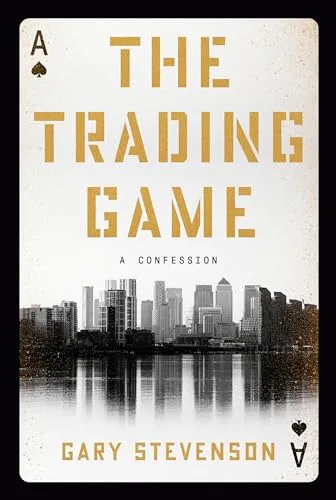
The Trading Game
A Confession
- Published
- 2024
- Pages
- 352 pages
- Publisher
- Crown Currency
- Readers
- 0 members have read this
A working-class kid from East London wins a Citibank card-game competition, lands on a short-term interest rate desk in 2008 and makes his name betting that rates would stay pinned near zero. The memoir shows how a bank trading desk actually earns its money, and what it costs the people who sit there.
Gary Stevenson grew up near Canary Wharf, got into the London School of Economics on the strength of his maths, and won Citibank's student contest, a card-based trading simulation that gave the book its title. The internship became a full-time job in 2008, when he was 21. His central trade was a simple macro view held with conviction: the post-crisis economy would stay weak, inequality would keep squeezing ordinary households, and so interest rates would not rise for years. By his account the bet made him Citibank's most profitable trader in 2011, while the money it made depended on the people he grew up with getting poorer.
The publisher pitches it as a Liar's Poker for a new generation, and reviewers kept making the comparison. Axios's Felix Salmon called it the clearest account he had read of how trading desks really work: how P&L drives pay, how bonuses are deferred, and why one right-time, right-place view can matter more than thousands of small trades. It became a number-one Sunday Times bestseller, was longlisted for the FT and Schroders Business Book of the Year, and Bloomberg named it the best Wall Street book of 2024.
The caveats are real. In September 2024 the Financial Times reported that eight former Citi colleagues disputed his claim to have been the bank's top trader, noting that Citi kept no official global ranking; Stevenson said he stood by the book. Some reviewers found the second half repetitive, the colleagues drawn as caricatures, and the narrator hard to like.
Read it for the mechanics of rates trading and the incentives on a bank desk, and read it knowing the self-assessments are his own.
- One right view can define a career. Stevenson made most of his money from a few large, long-held bets on rates staying low, not from the thousands of small trades he did every day.
- Read the real economy, not the model. His edge came from seeing that households were getting poorer and could not support rate hikes, while his team bet on a recovery.
- Your P&L is your pay, and it is deferred. The book lays out how bonuses track a trader's profit and are paid over years, which ties people to the job long after they want to leave.
- Desk profits can come from other people's pain. He presents the moral problem plainly: his best trades worked because conditions got worse for ordinary people.
- Treat self-reported rankings with care. Former colleagues publicly disputed his claim to be Citi's top trader, a reminder that trading memoirs describe P&L from one seat.
The memoir runs chronologically from a poor East London childhood to burnout in Tokyo, with the trading floor at its center.
- East London to the LSE. Stevenson describes a poor childhood near Canary Wharf, expulsion from grammar school for dealing drugs, and the class gap he felt at the London School of Economics.
- Winning the game. He wins Citibank's card-based trading competition, which turns into an internship and then, in 2008, a seat on a short-term interest rate trading desk as the bank's youngest trader.
- Learning the desk. Fetching lunches and watching, he learns how the desk makes money as European banks scramble for dollar funding, and he finds a mentor in a working-class trader who tells him to ignore the textbooks and watch the real economy decay.
- The big bet. While colleagues wager on recovery, he bets rates will stay near zero for years, a view that pays off hugely in 2011 and leaves him uneasy about profiting from events such as Japan's earthquake and nuclear disaster.
- Tokyo and the way out. Transferred to Tokyo, he slides into depression, and the final stretch covers his long fight to leave the bank without forfeiting his deferred pay.
- Leaving and after. He quits in 2014, studies economics at Oxford and turns to campaigning on inequality and wealth taxes.
Reader reviews
No reviews yet. Join to write the first one.