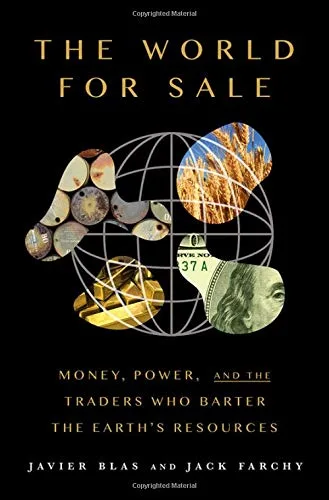
The World for Sale
Money, Power, and the Traders Who Barter the Earth's Resources
by Javier Blas and Jack Farchy
- Published
- 2021
- Pages
- 416 pages
- Publisher
- Oxford University Press
- Readers
- 5 members have read this
Two Bloomberg reporters tell the history of the independent commodity traders, including Glencore, Vitol, Trafigura and Marc Rich's firm, who move the world's oil, metals and grain. The book shows how a few lightly regulated firms profited from oil nationalizations, the Soviet collapse and China's boom, and how they gained political power along the way.
Commodity traders sit between producers and consumers, and most people never see them. Javier Blas and Jack Farchy argue that a small group of mostly Swiss-based, privately owned firms has become one of the most powerful forces in the global economy, willing to deal with Saddam Hussein, Arab Spring rebels, the Kremlin, apartheid South Africa and revolutionary Iran.
Blas and Farchy covered commodities for the Financial Times before moving to Bloomberg, Blas as a columnist on energy and commodities and Farchy as a senior reporter on natural resources. They interviewed more than 100 traders and worked through thousands of pages of corporate and court documents. That sourcing lets the book cover the whole industry, while earlier books such as Daniel Ammann's The King of Oil focused on Marc Rich.
Reviewers in the Economist, the Financial Times and Reuters praised the reporting, and Kirkus called it a valuable primer on the trade. Publishers Weekly noted that the authors sometimes waver between admiring their swashbuckling subjects and condemning them. The book is mostly told through stories, so readers looking for detail on how trading houses hedge and finance their books will find only an outline.
It is for energy and metals analysts, bankers who lend to trading houses, sanctions and compliance specialists, and anyone who wants to know who really sets physical commodity flows.
- Physical markets need middlemen. Traders make money from arbitrage across geography, time and quality, and from logistics, storage and credit. They are not mainly price speculators.
- Credit is the lifeblood of trading. The business depends on bank financing and letters of credit, so banks' tolerance for risk sets how far traders can go.
- Disorder is the opportunity. Nationalizations, the Soviet breakup, sanctions and civil wars created the most profitable openings for firms willing to work where majors would not.
- Reputation risk becomes legal risk. Practices once treated as a cost of doing business, such as bribes, sanctions evasion and opaque offshore structures, now draw large US and European penalties.
- Ownership shapes behavior. Private partnerships with concentrated ownership could take risks and keep secrets that listed companies could not. Glencore's listing showed how much wealth was locked inside them.
After an introduction on the last swashbucklers of global capitalism, the book follows the industry chronologically through thirteen chapters and ends with a conclusion about the skeletons in its closet.
- The pioneers. In the postwar decades the Seven Sisters controlled the oil market, while metal traders at Philipp Brothers, grain houses such as Cargill and a few early dealers in Soviet oil built the business.
- The age of Marc Rich. Middle East nationalizations broke the majors' grip and created a spot market for oil. Marc Rich, a former Philipp Brothers trader, became the industry's dominant figure, bank credit and oil futures made the business bigger, and US charges of tax evasion and trading with Iran turned Rich into a fugitive. His firm later became Glencore.
- Empires collapse, markets open. The fall of the Soviet Union produced what the authors call the biggest closing-down sale in history, and China's opening created an enormous new source of demand.
- Boom and kleptocracy. In the commodity supercycle, petrodollars flowed to kleptocrats, traders pushed into Africa and food-price crises became another source of profit.
- Billionaires and power. Glencore's 2011 listing made its partners billionaires. The authors describe how traders use their political reach, from Libya to Russia, and how US prosecutors began to rein them in.
The modern world is built on commodities - from the oil that fuels our cars to the metals that power our smartphones. We rarely stop to consider where they have come from. But we should. In The World for Sale, two leading journalists lift the lid on one of the least scrutinised corners of the world economy: the workings of the billionaire commodity traders who buy, hoard and sell the earth's resources. It is the story of how a handful of swashbuckling businessmen became indispensable cogs in global markets: enabling an enormous expansion in international trade, and connecting resource-rich countries - no matter how corrupt or war-torn - with the world's financial centres. And it is the story of how some traders acquired untold political power, right under the noses of western regulators and politicians - helping Saddam Hussein to sell his oil, fuelling the Libyan rebel army during the Arab Spring, and funnelling cash to Vladimir Putin's Kremlin in spite of western sanctions. The result is an eye-opening tour through the wildest frontiers of the global economy, as well as a revelatory guide to how capitalism really works.
Reader reviews
No reviews yet. Join to write the first one.