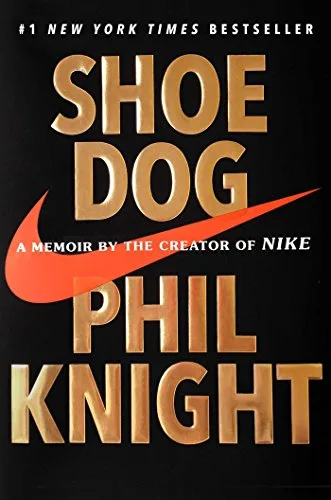
Shoe Dog
A Memoir by the Creator of Nike
by Phil Knight
- Published
- 2016
- Pages
- 400 pages
- Publisher
- Scribner
- Readers
- 7 members have read this
Nike founder Phil Knight's memoir covers the 18 years between a Stanford term paper about Japanese running shoes and Nike's 1980 IPO. For finance readers it is one of the most honest accounts of what it means to run a fast-growing company short of cash: bankers cutting off credit, a supplier turning rival, and a customs bill that could have ended it all.
Knight's memoir is Nike's origin story, from his crazy idea after Stanford business school to the struggle to keep the company alive while it grew faster than its capital.
No one else could have written it. Knight was Nike's chief executive from its founding until 2004 and its chairman until 2016, and he had rarely spoken about himself in public. The memoir was ghostwritten with J. R. Moehringer, and it reads like a novel. Bill Gates called it a refreshingly honest picture of what business success really looks like, Warren Buffett named it the best book he read that year, and Forbes's Rich Karlgaard put it alongside Isaacson's Steve Jobs as business biography.
What sets it apart from most founder memoirs is how much it dwells on finance: reinvesting every dollar in inventory, banks cutting his credit line, and a Japanese trading house becoming his real lender. The obvious gap is that the narrative mostly stops in 1980. The later Nike, including the 1990s criticism of factory conditions, gets only a brief, defensive treatment in the closing reflections.
It suits founders, lenders, growth investors and anyone who has had to manage working capital in a business that is outgrowing its balance sheet.
- Growth eats cash. Nike's sales doubled year after year while the company stayed on the edge of insolvency, because inventory and receivables grew faster than profits. A lender that understands that dynamic is a strategic asset.
- Conservative banks fund the past, not the future. Knight's banks kept asking him to slow down. Nissho Iwai's trade finance worked because it was secured by the goods themselves and tied to growth.
- Supplier dependence is existential. Building the whole business on Onitsuka's product left Knight one contract away from ruin. Launching Nike was as much a hedge against that as a branding decision.
- Regulation can be a competitive weapon. Rivals used customs valuation rules to try to bury Nike. Investors should look at which legal and trade exposures a competitor could exploit.
- Culture compounds. The odd early team Knight hired and trusted, with loose structure and ruthless candor, scaled into a durable organization. Founders who delegate to committed people can outrun better-financed incumbents.
The book opens in 1962 and moves through chapters named for each year to 1980, then closes with a reflective final section.
- The crazy idea, 1962-64. After a morning run, the 24-year-old Knight resolves to act on his Stanford paper. He travels the world, cold-calls Onitsuka in Japan and starts Blue Ribbon Sports with Bowerman, selling Tigers from his car.
- The misfits, mid-1960s. Knight builds a team of oddballs, including Jeff Johnson, Bob Woodell and Delbert Hayes, while working as an accountant and teaching at Portland State, where he meets his wife, Penny.
- Break with Onitsuka, 1971-74. Fearing Onitsuka will cut him out, Knight launches the Nike brand, with Carolyn Davidson's swoosh and Bowerman's waffle sole. A court fight with his former supplier follows.
- Running on empty, mid-1970s. Explosive growth outruns financing. A bank freezes the account and the FBI gets involved, and Nissho Iwai steps in as lender. Steve Prefontaine's death hits the company hard.
- The customs fight and the IPO, 1977-80. Competitors use an obscure duty rule to saddle Nike with a ruinous back-tax bill. Knight fights it in Washington, settles, and takes the company public in December 1980.
- Night. In closing reflections Knight looks back on later decades, his critics and the death of his son Matthew.
In this instant and tenacious New York Times bestseller, Nike founder and board chairman Phil Knight offers a rare and revealing look at the notoriously media-shy man behind the swoosh” (Booklist, starred review), illuminating his company’s early days as an intrepid start-up and its evolution into one of the world’s most iconic, game-changing, and profitable brands. Bill Gates named Shoe Dog one of his five favorite books of 2016 and called it an amazing tale, a refreshingly honest reminder of what the path to business success really looks like. It’s a messy, perilous, and chaotic journey, riddled with mistakes, endless struggles, and sacrifice. Phil Knight opens up in ways few CEOs are willing to do.” Fresh out of business school, Phil Knight borrowed fifty dollars from his father and launched a company with one simple mission: import high-quality, low-cost running shoes from Japan. Selling the shoes from the trunk of his car in 1963, Knight grossed eight thousand dollars that first year. Today, Nike’s annual sales top $30 billion. In this age of start-ups, Knight’s Nike is the gold standard, and its swoosh is one of the few icons instantly recognized in every corner of the world. But Knight, the man behind the swoosh, has always been a mystery. In Shoe Dog, he tells his story at last. At twenty-four, Knight decides that rather than work for a big corporation, he will create something all his own, new, dynamic, different. He details the many risks he encountered, the crushing setbacks, the ruthless competitors and hostile bankers—as well as his many thrilling triumphs. Above all, he recalls the relationships that formed the heart and soul of Nike, with his former track coach, the irascible and charismatic Bill Bowerman, and with his first employees, a ragtag group of misfits and savants who quickly became a band of swoosh-crazed brothers. Together, harnessing the electrifying power of a bold vision and a shared belief in the transformative power of sports, they created a brand—and a culture—that changed everything.
Reader reviews
No reviews yet. Join to write the first one.