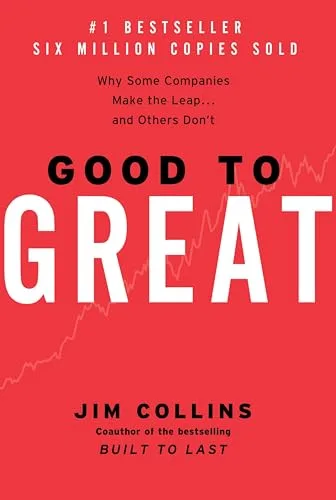
Good to Great
Why Some Companies Make the Leap... and Others Don't
by Jim Collins
- Published
- 2001
- Pages
- 320 pages
- Publisher
- Harper Business
- Readers
- 6 members have read this
Jim Collins's research team screened every company that had appeared on the Fortune 500 for ones whose stock went from tracking the market to beating it threefold for 15 years, found 11, and compared them with rivals that did not make the leap. The resulting ideas, from Level 5 leadership to the hedgehog concept, shaped a generation of managers, and investors should read the critiques too.
Jim Collins, a former Stanford Graduate School of Business lecturer and co-author with Jerry Porras of Built to Last, set out to answer a question that book left open: can a merely good company become great? His team screened the Fortune 500 for companies whose stock returns ran at or below the market for 15 years, then at least three times the market over the next 15. Eleven passed, among them Circuit City, Fannie Mae, Kroger, Nucor and Wells Fargo, and each was paired with a comparison company in the same industry.
The findings cut against fashion. The leaders who drove the transitions were humble and stubborn rather than charismatic, technology was an accelerator rather than a cause, and the change came from steady accumulated effort, the flywheel, rather than a dramatic program. Peter Drucker praised it for disproving much management hype, and the Financial Times noted how much research stood behind its simple conclusions.
The critiques matter for finance readers. Steven Levitt calculated that a portfolio of the 11 would have trailed the S&P 500 after the book came out, with only Nucor clearly outperforming; Circuit City went bankrupt and Fannie Mae was taken over by the government in 2008. Phil Rosenzweig, in The Halo Effect, argued that the study relied on press accounts colored by success and could not separate cause from correlation.
Read it for the management vocabulary, for thinking about how businesses compound, and as a case study in survivorship bias.
- Look for quiet, driven management. The leaders behind the transitions were modest in public and relentless about results, a useful counterweight to investors' attraction to celebrity CEOs.
- Find the company's hedgehog. The hedgehog concept, the overlap of what a firm can be best at, what drives its economics and what its people care about, is a way to judge whether a strategy has a real edge.
- Watch the economic denominator. Collins asked each company for the single ratio, such as profit per customer visit, that best captured its economic engine. Analysts can ask the same question.
- Momentum is built, not announced. Transformations came from years of consistent effort. Big restructurings, splashy acquisitions and new programs were more typical of the companies that failed.
- Beware outcome-selected research. Several of the 11 later faltered, and critics argue the study confused correlation with cause. Treat any list of winners chosen after the fact with skepticism.
After an opening chapter arguing that good is the enemy of great, Collins presents his framework in roughly the order the transitions unfolded, in three stages of disciplined people, thought and action.
- Disciplined people. Level 5 leadership describes executives who combine personal humility with intense professional will. First who, then what argues that the companies got the right people on the bus before deciding where to drive it.
- Disciplined thought. Confront the brutal facts, yet never lose faith introduces the Stockdale Paradox. The hedgehog concept asks what a company can be best in the world at, what drives its economic engine and what its people are deeply passionate about.
- Disciplined action. A culture of discipline pairs freedom with responsibility inside a clear framework, and technology accelerators shows that the companies used technology to speed momentum, not to create it.
- The flywheel and the doom loop. Collins contrasts the steady build-up of momentum at the good-to-great companies with the comparison firms' lurches between programs, leaders and acquisitions.
- From good to great to built to last. The final chapter connects the findings to Built to Last and the question of enduring greatness, followed by appendices on the research method.
The Challenge Built to Last, the defining management study of the nineties, showed how great companies triumph over time and how long-term sustained performance can be engineered into the DNA of an enterprise from the verybeginning. But what about the company that is not born with great DNA? How can good companies, mediocre companies, even bad companies achieve enduring greatness? The Study For years, this question preyed on the mind of Jim Collins. Are there companies that defy gravity and convert long-term mediocrity or worse into long-term superiority? And if so, what are the universal distinguishing characteristics that cause a company to go from good to great? The Standards Using tough benchmarks, Collins and his research team identified a set of elite companies that made the leap to great results and sustained those results for at least fifteen years. How great? After the leap, the good-to-great companies generated cumulative stock returns that beat the general stock market by an average of seven times in fifteen years, better than twice the results delivered by a composite index of the world's greatest companies, including Coca-Cola, Intel, General Electric, and Merck. The Comparisons The research team contrasted the good-to-great companies with a carefully selected set of comparison companies that failed to make the leap from good to great. What was different? Why did one set of companies become truly great performers while the other set remained only good? Over five years, the team analyzed the histories of all twenty-eight companies in the study. After sifting through mountains of data and thousands of pages of interviews, Collins and his crew discovered the key determinants of greatness -- why some companies make the leap and others don't. The Findings The findings of the Good to Great study will surprise many readers and shed light on virtually every area of management strategy and practice. The findings include: Level 5 Leaders: The research team was shocked to discover the type of leadership required to achieve greatness. The Hedgehog Concept (Simplicity within the Three Circles): To go from good to great requires transcending the curse of competence. A Culture of Discipline: When you combine a culture of discipline with an ethic of entrepreneurship, you get the magical alchemy of great results. Technology Accelerators: Good-to-great companies think differently about the role of technology. The Flywheel and the Doom Loop: Those who launch radical change programs and wrenching restructurings will almost certainly fail to make the leap. Some of the key concepts discerned in the study,” comments Jim Collins, fly in the face of our modern business culture and will, quite frankly, upset some people.” Perhaps, but who can afford to ignore these findings?
Reader reviews
No reviews yet. Join to write the first one.