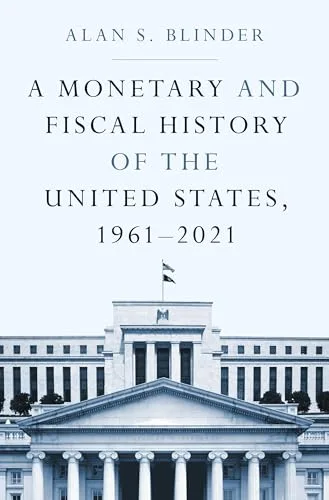
A Monetary and Fiscal History of the United States, 1961–2021
- Published
- 2022
- Pages
- 432 pages
- Publisher
- Princeton University Press
- Readers
- 1 member has read this
A former Fed vice chair tells the story of sixty years of American macro policy, from Kennedy's tax cut to the pandemic rescue, across twelve presidents and eight Fed chairs. For anyone who trades rates or reads the Fed, it shows how today's playbook came out of stagflation, Volcker, Reaganomics, the 2008 crisis and COVID-19, and how politics shaped each turn.
Alan Blinder picks up in 1961, the year after Milton Friedman and Anna Schwartz's Monetary History of the United States ends, and carries the story through 2021. His subject is the interaction between the two arms of macroeconomic policy: the Federal Reserve, which mostly sets rates free of politics, and the fiscal side, where elected officials decide taxes and spending and where, as he puts it, political logic often beats economic logic.
Few economists have seen this machinery from as many angles. Blinder is a Princeton professor, served on President Clinton's Council of Economic Advisers and as vice chair of the Fed, and wrote After the Music Stopped, a history of the 2008 crisis.
The book is deliberately light on theory, covering ideas such as monetarism and supply-side economics because they changed policy. Blinder states up front that he is a center-left Democrat and says he tried to keep his politics in the background. Tyler Cowen called it a very good introduction from a mainstream point of view, Robert Gordon called it the definitive history of the period, and Choice named it an Outstanding Academic Title.
It works as both a narrative history and a reference. Rates strategists, macro investors and anyone trying to anticipate how Washington will respond to the next recession will find it useful.
- Monetary and fiscal policy must be read together. Many turning points, from Reaganomics to 2020, came when the Fed and Congress either reinforced or worked against each other.
- Politics drives fiscal policy. Budget decisions follow political logic, so forecasts of stimulus or austerity need to start with Congress, not with economic models.
- Fed independence is valuable and fragile. The Nixon-Burns episode shows what happens when a Fed chair bends to the White House, a lesson relevant whenever presidents pressure the central bank.
- Inflation expectations are hard to rebuild. The 1970s and Volcker's response show how costly it is to restore credibility once inflation becomes entrenched.
- Crisis tools become permanent. Quantitative easing, emergency lending and Fed-Treasury cooperation, born in 2008 and expanded in 2020, are now part of the standard toolkit that markets price.
The book has nineteen chronological chapters after an introduction. They fall into six broad phases.
- The New Frontier to the vertical Phillips curve. Fiscal activism under Kennedy and Johnson, the rise of inflation and monetarism, and the collapse of the belief in a stable trade-off between inflation and unemployment.
- The inflationary 1970s. Nixon, Arthur Burns and the political business cycle, the supply shocks of stagflation, and the rational expectations revolution in economics.
- Volcker and Reagan. Carter's appointment of Paul Volcker and the conquest of inflation, then Reaganomics, in which tight money and large deficits pulled in opposite directions, and the long expansion of the 1980s.
- Deficits and the long boom. How deficits from 1982 to 1998 crowded out active fiscal policy, and how the Greenspan Fed and budget deals underpinned the boom of the 1990s.
- Bubbles and crisis. The job-loss recovery and the bubbles of the 2000s, the financial crisis and Great Recession, the joint Fed-Treasury response, the political backlash and the record expansion of the 2010s.
- Trump and the pandemic. Fiscal and monetary policy before COVID-19, the enormous response to it, and a closing chapter on what changed over sixty years.
In this book, Alan Blinder, one of the world’s most influential economists and one of the field’s best writers, draws on his deep firsthand experience to provide an authoritative account of sixty years of monetary and fiscal policy in the United States. Spanning twelve presidents, from John F. Kennedy to Joe Biden, and eight Federal Reserve chairs, from William McChesney Martin to Jerome Powell, this is an insider’s story of macroeconomic policy that hasn’t been told before―one that is a pleasure to read, and as interesting as it is important.
Focusing on the most significant developments and long-term changes, Blinder traces the highs and lows of monetary and fiscal policy, which have by turns cooperated and clashed through many recessions and several long booms over the past six decades. From the fiscal policy of Kennedy’s New Frontier to Biden’s responses to the pandemic, the book takes readers through the stagflation of the 1970s, the conquest of inflation under Jimmy Carter and Paul Volcker, the rise of Reaganomics, and the bubbles of the 2000s before bringing the story up through recent events―including the financial crisis, the Great Recession, and monetary policy during COVID-19.
A lively and concise narrative that is sure to become a classic, A Monetary and Fiscal History of the United States, 1961–2021 is filled with vital lessons for anyone who wants to better understand where the economy has been―and where it might be headed.
Reader reviews
No reviews yet. Join to write the first one.