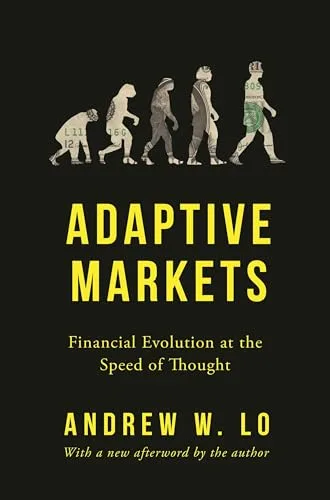
Adaptive Markets
Financial Evolution at the Speed of Thought
by Andrew W. Lo
- Published
- 2017
- Pages
- 504 pages
- Publisher
- Princeton University Press
- Readers
- 3 members have read this
MIT finance professor and quant fund founder Andrew Lo tries to settle the fight between efficient-market theorists and behavioral economists. Markets, he argues, are efficient in some environments and not others, because investors adapt and compete like species. It explains why strategies stop working, why crises spread so fast, and why risk premiums are not constant.
For half a century, finance has been split between the efficient market hypothesis, which says prices reflect all available information, and behavioral finance, which catalogs how investors misbehave. Andrew Lo argues that both are right some of the time. In his Adaptive Markets Hypothesis, investors use heuristics that work well in a stable environment and misfire when conditions change. Efficiency depends on competition and how quickly participants adapt, and survival, not optimization, is the main objective.
Lo is unusually well placed to make the case. He is a professor at MIT Sloan, directs its Laboratory for Financial Engineering, and founded the quantitative asset manager AlphaSimplex Group in 1999. His earlier books include A Non-Random Walk Down Wall Street (with A. Craig MacKinlay).
The book ranges widely over psychology, neuroscience, evolutionary biology and artificial intelligence before turning to hedge funds, the 2007-2008 crisis and regulation. Reviewers praised its clarity: John Authers of the Financial Times wrote that its ideas should help investors and regulators manage risk better. The main caveat is its length: more than 500 pages, with the practical investing material concentrated in the second half.
It is essential for quants, asset allocators and risk managers who have watched a model that worked for years suddenly stop.
- Efficiency is a variable, not a constant. Markets are more efficient when many competitors chase scarce opportunities and less efficient when conditions change faster than participants adapt.
- Strategies have life cycles. An edge attracts capital, gets crowded and decays. A backtest that covers one regime says little about the next.
- Risk premiums move. The link between risk and reward changes with the population of investors and the environment, so rules like stocks for the long run are not guaranteed.
- Stress makes everyone act alike. In a crisis, correlations jump and diversification fails just when you need it, so plan for crowded exits.
- Survival comes first. In an evolutionary market, the players who last are the ones who avoid ruin. Risk management that adapts to conditions matters more than maximizing expected return.
Lo builds the argument in twelve chapters that move from the old debate to a new theory and then to practice and policy.
- The debate. The opening chapters set out the efficient market hypothesis and its critics, under titles such as If You're So Smart, Why Aren't You Rich? and If You're So Rich, Why Aren't You Smart?
- Mind and evolution. Lo draws on neuroscience, the power of narrative and evolutionary biology to explain how fear, greed and heuristics developed, and why behavior that is adaptive in one setting looks irrational in another.
- The hypothesis. Chapter six states the Adaptive Markets Hypothesis. Chapter seven treats the hedge fund industry as the Galapagos Islands of finance, where strategies emerge, compete and die out quickly, and where the most finely adapted funds are the most exposed when conditions shift, as quant funds found in August 2007.
- In action. Lo looks at how investors should think about a world where the long period of calm he calls the Great Modulation has ended. Passive investing and fixed asset allocations can no longer be relied on, and risk premiums change over time.
- Crisis and misconduct. Chapters on fear, greed and the 2008 crisis, and on how culture and incentives lead finance to behave badly.
- Fixing finance and beyond. Proposals for adaptive regulation and better risk buffers, ending with a look at using financial engineering for big goals such as funding biomedical research.
A new, evolutionary explanation of markets and investor behavior Half of all Americans have money in the stock market, yet economists can’t agree on whether investors and markets are rational and efficient, as modern financial theory assumes, or irrational and inefficient, as behavioral economists believe. The debate is one of the biggest in economics, and the value or futility of investment management and financial regulation hangs on the answer. In this groundbreaking book, Andrew Lo transforms the debate with a powerful new framework in which rationality and irrationality coexist—the Adaptive Markets Hypothesis. Drawing on psychology, evolutionary biology, neuroscience, artificial intelligence, and other fields, Adaptive Markets shows that the theory of market efficiency is incomplete. When markets are unstable, investors react instinctively, creating inefficiencies for others to exploit. Lo’s new paradigm explains how financial evolution shapes behavior and markets at the speed of thought—a fact revealed by swings between stability and crisis, profit and loss, and innovation and regulation. An ambitious new answer to fundamental questions about economics and investing, Adaptive Markets is essential reading for anyone who wants to understand how markets really work.
Reader reviews
No reviews yet. Join to write the first one.